How HappyOyster Turns Video Generation Into World Simulation
The strongest way to understand HappyOyster is to stop thinking only about clips. The more accurate mental model is that Alibaba is pushing from generated outputs toward generated environments.
That shift is what makes the product interesting. It suggests that the unit of value may become the world, not just the shot.
From Rendering Clips To Simulating Spaces
A normal video generator gives you a path through a scene. A world-model product tries to give you a scene that keeps responding. That is the key conceptual move from video generation to world simulation.
Why Persistence And Interaction Matter
A simulated world is more useful than a fixed clip when the user needs to ask follow-up questions with movement: what happens if I change direction, alter the lighting, insert a new object, or move deeper into the scene? That is where simulation starts to matter more than output alone.
What This Changes For Creative Workflows
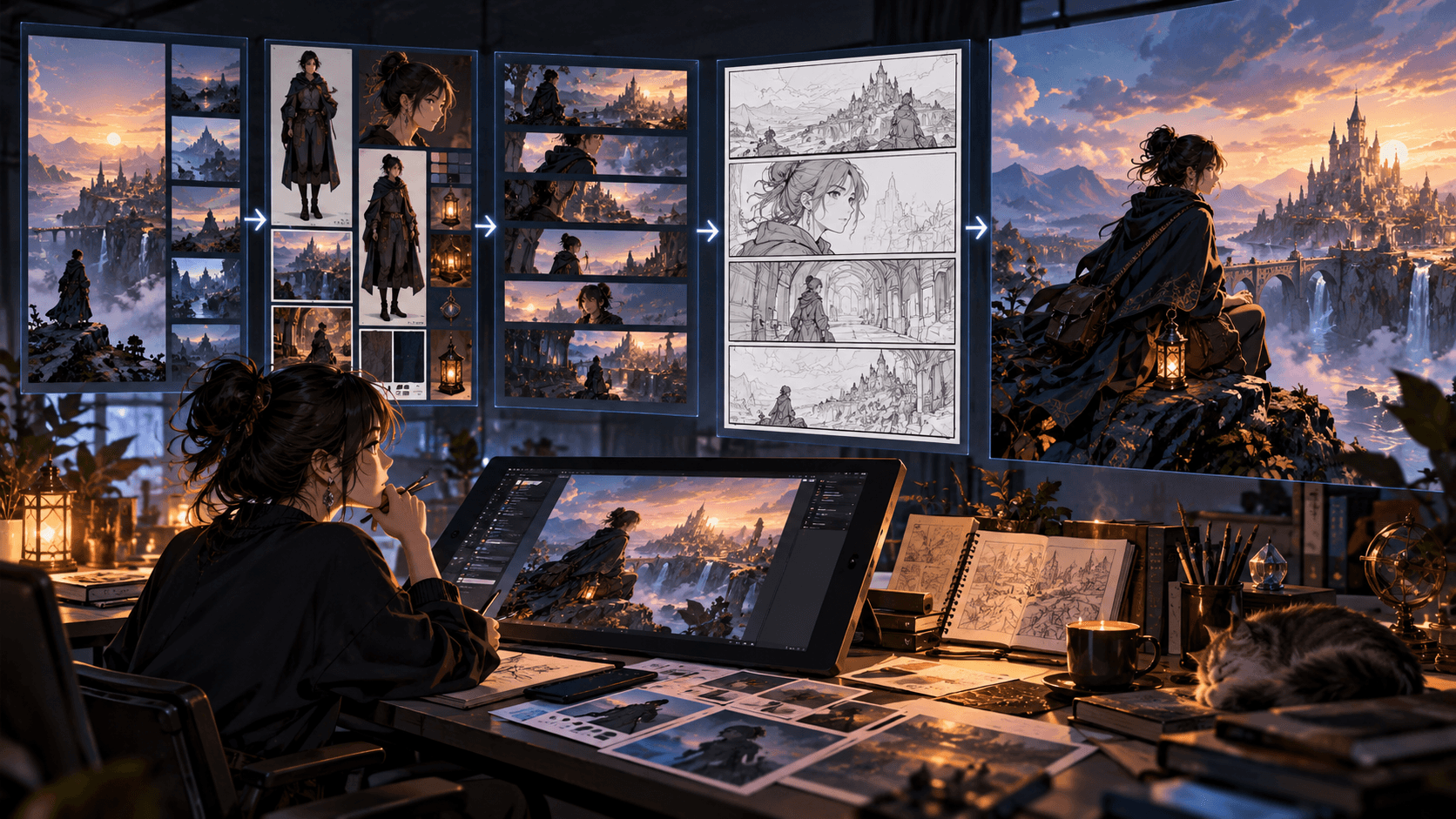
For creators, the shift means that ideation and exploration may become less linear. Instead of drafting one scene at a time, they may explore a space and discover scenes from inside it. That is a meaningful workflow change, even if it remains early.
If your process already has the right still image and only needs motion, an image-to-video tool is often easier to operationalize.
Where Classic Video Models Still Win
World simulation does not instantly replace clip generation. If the task is exporting a polished ad, a short-form edit, or a tightly timed motion asset, classic video models may still be more direct and more usable today.
If you want to turn world-model curiosity into a usable creative workflow, Elser AI production workflow is the steadier production layer.
Why This Topic Is Getting Attention Now
How HappyOyster Turns Video Generation Into World Simulation is getting attention now because the topic sits at the intersection of product change, market curiosity, and practical workflow consequences. People are not only searching for a definition. They are trying to understand whether the shift is large enough to change how they evaluate tools, teams, or production plans.
That is why simple surface-level summaries often feel unsatisfying. The public conversation moves quickly, but the real decision usually comes later. Readers need a version of the story that separates what is genuinely new from what is merely louder than before.
What The Public Record Actually Supports
Based on the sources already cited in the article, the public record supports a focused but meaningful conclusion. It tells us that this topic is not random noise, that it connects to a world-model product framed around interaction rather than only output generation, and that there are enough concrete signals to take it seriously. At the same time, it does not flatten every uncertainty into a solved case.
That balance matters. The strongest articles on fast-moving AI topics are the ones that show where the evidence is solid, where the language should stay cautious, and why the nuance still matters for readers who may need to act on the information.
What People Commonly Get Wrong
What people often get wrong is the distance between attention and maturity. A topic can be strategically important without already being simple, stable, or universally useful. The rush to overinterpret early signals is one of the most common failure modes in AI coverage, especially when the public story spreads faster than the operational details.
Another common mistake is asking the wrong question. Readers sometimes ask whether the topic is “real” when the more useful question is what kind of value it actually creates, for whom, and under what conditions. That framing produces much better decisions than a binary hype-versus-fake mindset.
What It Means For Creators And Teams
For creators and teams, the practical meaning usually comes back to fit. Does the topic matter for interactive previs, world exploration, and story environment design? Does it change how a team should think about product maturity, controllability, access, and whether the experience maps to a real workflow? If the answer is yes, then the topic deserves a place in active evaluation, even if the final operational answer is still evolving.
That is why sensible teams do not wait for a perfect information environment before they respond. They create a lightweight framework for reading change: what is confirmed, what is inferred, what needs testing, and what can safely wait. That framework often matters more than any single news cycle.
What To Watch Next
The next useful signals are the ones that reduce ambiguity rather than increase excitement. That may mean stronger documentation, more transparent access terms, broader testing, clearer product positioning, or better evidence that the topic belongs inside a real workflow. Those are the signals that move the story from interesting to actionable.
Until then, the best posture is informed attention. Treat the topic as important enough to understand, but not so settled that it no longer deserves careful reading. That balance tends to produce better long-term decisions than either blind enthusiasm or lazy dismissal.
How To Evaluate The World Simulation Claim
The easiest way to evaluate the claim is to ask whether the system behaves like a reusable environment or just a sequence of impressive clips. Can the user revisit the same space, change intent midway, and still get behavior that feels coherent? Can the product support exploration, not only generation? Those are stronger questions than asking whether a demo video looks futuristic.
This standard is useful because many AI launches borrow the language of simulation before they truly deliver simulation behavior. A product does not become a world model simply because it produces rich motion or immersive camera movement. The test is whether interaction, continuity, and responsiveness hold up when the user moves beyond the first showcase example.
Where This Could Become Operationally Valuable
If HappyOyster continues moving in the direction implied by current coverage, the most immediate value may appear in previs, virtual scouting, interactive story exploration, and game-like creative prototyping. Those are categories where discovering a space matters almost as much as rendering a final shot. In those settings, a world-like system can change how teams think, not just what they export.
For more conventional marketing or short-form production, however, the old standards still apply. Teams will still ask about control, repeatability, asset ownership, integration, and turnaround speed. That is why world simulation is best treated as a meaningful new direction, but not yet a universal replacement for practical video pipelines.
Bottom Line
HappyOyster matters because it reframes the problem. Instead of asking only how to generate a better clip, it asks how to generate a responsive world. That is a bigger leap if it works.