Can GPT-6 Astra Generate Images, Videos or Audio? Capabilities and Limitations
GPT-6 Astra itself produces text. It accepts text and image inputs, but the current official model page lists audio and video as unsupported model modalities. Astra can call an image-generation tool through the Responses API, which means an Astra-powered application may return an image even though the base model is not the renderer.
That distinction explains many contradictory descriptions online. “The model understands images,” “the app can generate an image” and “the model outputs video” are three different claims.
The Capability Matrix
Based on the official GPT-6 Astra model page, verified September 4, 2026:
| Capability | GPT-6 Astra status | What it means | | Text input | Supported | It can read prompts and text context | | Text output | Supported | Its native response is text | | Image input | Supported | It can analyze supplied images | | Image-generation tool | Supported | It can call a configured image tool in Responses | | Native audio input/output | Not supported | Use specialized audio models or tools | | Native video input/output | Not supported | Use specialized video or animation systems |
The model page also lists endpoints for images, video and audio elsewhere in the platform. An endpoint being present on a platform page does not turn every model into every modality. The relevant evidence is the model's modality and tool tables.
Image Understanding: What Image Input Enables
Image input lets Astra reason about a supplied visual. Useful tasks include:
- describing composition and hierarchy;
- extracting visible text;
- comparing two interface states;
- identifying continuity differences between character frames;
- reviewing a storyboard for coverage;
- converting a visual reference into a structured production brief.
Results remain interpretations. Small text, ambiguous anatomy, exact color values and off-screen context may be misread. If a decision matters, provide a high-quality image, describe the task narrowly and ask the model to separate observation from inference.
For a character reference, a good request might be:
Analyze only visible, production-relevant traits. Return face shape, hairstyle,
palette, outfit construction, accessories and uncertain details. Do not invent
personality or backstory. Mark traits that cannot be confirmed from this view.
That output can become a continuity checklist for later scene generation.
Image Generation: Model Reasoning Plus a Separate Tool
The Astra tool table lists image generation as supported through the Responses API. In this arrangement, Astra interprets the request, may refine instructions and calls the configured generation tool. The tool creates the visual output.
Why does the distinction matter?
First, billing may include tool-specific charges. Second, size, format and editing controls belong to the generation tool rather than the reasoning model alone. Third, a failed image can come from prompt interpretation, tool settings or the renderer. Debugging requires knowing which layer made which decision.
An application can use Astra to:
- inspect a reference;
- extract stable traits;
- create a generation brief;
- call an image tool;
- compare the result with the brief;
- propose a focused revision.
This is more useful than describing the entire process as “GPT-6 drew it.”
For animation-ready assets: Develop the brief with Astra, then use Elser AI to create and save the character within the same storyboard and animation workflow.
Video: Planning Is Not Rendering
The current Astra page marks video as unsupported. The model cannot natively return a finished video clip from its text-output channel.
It can still contribute to nearly every decision before rendering:
- adapt a concept into a timed script;
- divide a scene into shots;
- write camera and motion instructions;
- track character and prop continuity;
- plan transitions and sound bridges;
- critique frames or storyboards supplied as images;
- produce structured prompts for a video system.
The output should be called a script, shot list, storyboard specification or video prompt—not a generated video.
This boundary is useful. Video errors are expensive because motion, identity, camera and timing can fail at once. Using Astra to resolve story logic before generation reduces the number of variables passed to the renderer.
Audio: Use Dedicated Voice, Music and Sound Tools
Audio is also listed as unsupported for the Astra model itself. It does not natively listen to a track or output spoken dialogue through the model modality described on its page.
Astra can write:
- a voice-performance brief;
- dialogue sized to a target duration;
- pronunciation notes;
- music direction by dramatic beat;
- sound-effect cue sheets;
- subtitle and localization drafts.
Actual speech, music, sound effects, transcription or audio analysis require relevant models, endpoints or external tools. For cloned voices, obtain permission and verify commercial-use rights.
A Complete Multimedia Workflow
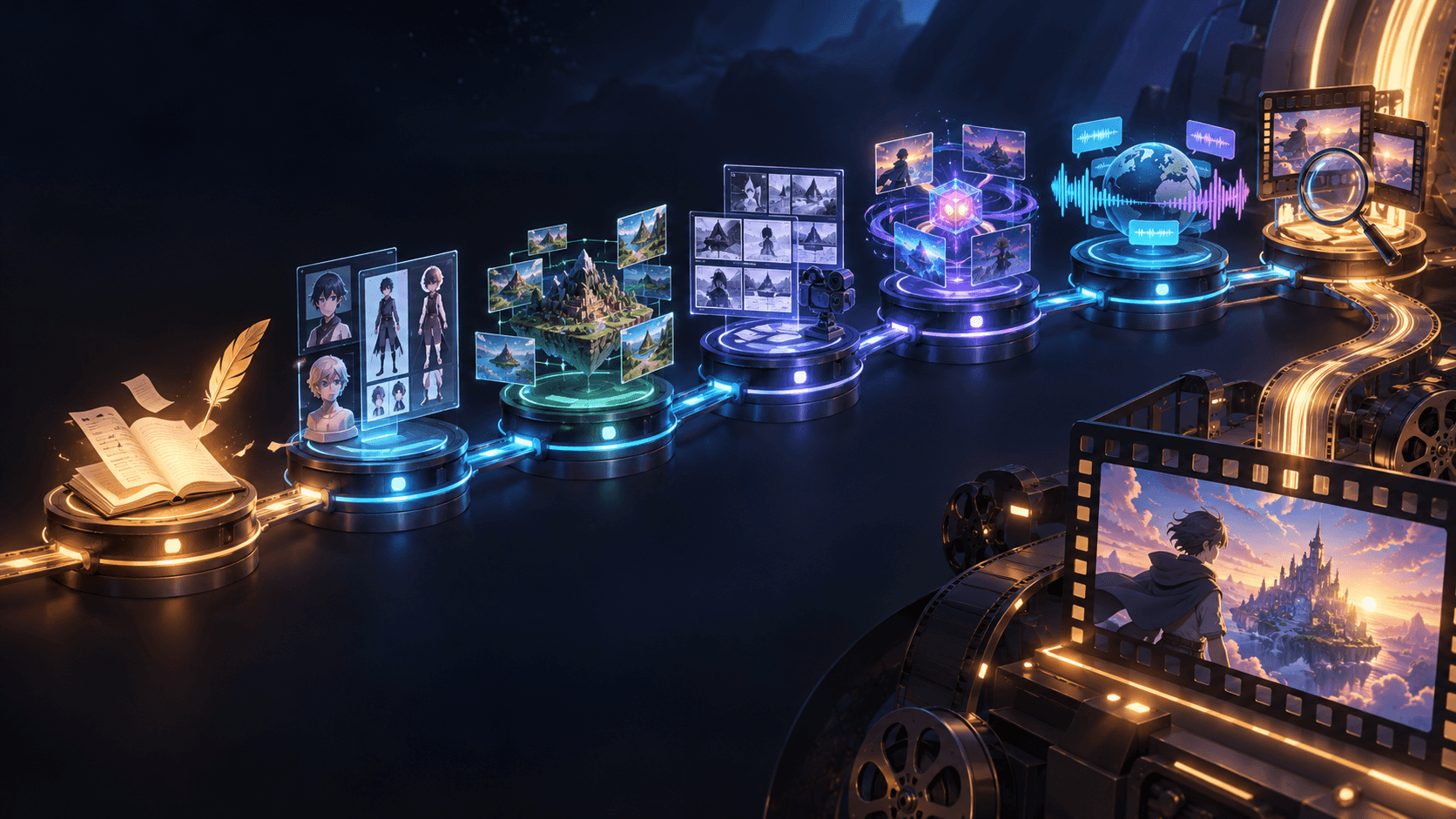
Here is a practical division of labor for a 45-second anime trailer.
Stage 1: Story reasoning
Ask Astra to turn a premise into a dramatic arc with a target runtime. Require visible action and remove exposition that cannot be shown or heard.
Stage 2: Character specification
Supply approved reference images. Ask Astra to extract stable traits and flag uncertainty. Human reviewers decide which details become canonical.
Stage 3: Shot design
Generate a table with purpose, framing, subject action, camera, duration, lighting, continuity and audio cue. Ensure total duration matches the target.
Stage 4: Visual production
Create or import the character in Elser AI, build the storyboard, approve keyframes and generate the scenes. Choose image-to-video when a locked first frame matters; use text-to-video for exploratory shots where exact starting composition matters less.
Stage 5: Audio and edit
Generate or add voices, music and effects in the production environment. Assemble the sequence, fix the weakest shots and verify subtitles, timing and rights.
Stage 6: Quality control
Return contact sheets or selected frames to Astra for a checklist-based comparison if useful, but keep human review for identity, artifacts, pacing and factual claims.
The handoff makes responsibilities clear: Astra helps reason about the production; the media system produces and edits it.
What “Multimodal” Should Mean in an Article
The word multimodal is often used too loosely. A responsible explanation names each direction:
- text in;
- image in;
- text out;
- tool call out;
- tool result returned to the application.
Do not infer native video understanding from image input. Do not infer native image rendering from the presence of an image tool. Do not infer real-time speech from a Realtime endpoint listed elsewhere on a platform page.
This precision supports SEO because it answers the user's actual question. Someone searching “Can GPT-6 generate video?” needs a direct boundary and an alternative workflow, not a vague claim that everything is multimodal.
Use Cases by Creator Type
YouTuber or short-form creator
Use Astra for hooks, narrative compression, B-roll plans and caption variants. Produce and edit actual media in dedicated tools.
Animator
Use it for character bibles, shot logic, continuity matrices and critique. Keep visual identity decisions in the animation project.
Game narrative designer
Use it to organize lore, branch dialogue and quest dependencies. Generate concept art through an image tool and maintain versioned assets separately.
Marketing team
Use it to transform a campaign brief into channel-specific scripts while preserving approved claims. Apply human brand and legal review before production.
Developer
Use the Responses API to orchestrate model reasoning and authorized tools. Log model responses and tool results separately for observability.
Common Misconceptions
“Image input means image output”
It does not. Input and output modalities are separate specifications.
“The Responses API can generate an image, so Astra is an image model”
Astra can call the image-generation tool. The reasoning model and generation tool remain distinct components.
“There is a video endpoint, so this model returns video”
The Astra modality table says video is unsupported. A platform can expose specialized endpoints that use other models.
“A text prompt can unlock unsupported audio”
Prompts control behavior within available capabilities; they do not add a native modality.
“A good shot list guarantees a good video”
It reduces ambiguity. Rendering still requires model selection, references, iteration and quality review.
How to Write Better Media Prompts with Astra
For each shot, request five layers:
- Subject: who or what is present;
- Action: one primary visible movement;
- Environment: location, time and secondary motion;
- Camera: framing and one motivated move;
- Continuity: traits and objects that must remain stable.
Example:
A silver-haired courier tightens her glove as the train doors open; rain moves
across the platform behind her; medium close-up with a slow five-percent push;
end on her glance toward the empty track. Preserve the red scarf, left-ear
silver cuff, navy jacket, wet-night lighting and hand-drawn anime line quality.
No new character and no camera orbit.
The prompt is useful because it describes a producible shot. Build the corresponding character and keyframe in Elser AI, then review identity before adding motion.
Frequently Asked Questions
Can GPT-6 Astra create images?
It can call an image-generation tool through the Responses API. Its native output modality is text.
Can GPT-6 Astra watch a video?
The current model page marks video as unsupported. Do not claim native video input without updated official documentation.
Can GPT-6 Astra make a video from text?
Not directly. It can write the script, shot list and prompts for a separate video or animation system.
Can GPT-6 Astra generate voiceovers?
Not through its native modality. Use a specialized voice or audio tool after it prepares the dialogue and performance brief.
Does GPT-6 Astra understand images?
Yes, image input is supported. Accuracy depends on the image and task, so confirm important details.
Is tool-generated media included in token pricing?
Do not assume so. OpenAI notes that tool-specific models and calls can have separate fees.
Conclusion
GPT-6 Astra is a text-output reasoning model with image understanding and broad tool-calling support. It can orchestrate image generation, but it does not natively output audio or video under the current specifications.
Use that boundary to design a stronger pipeline. Let Astra clarify the idea, script, shot logic and continuity. Then use Elser AI to generate the characters, storyboard, animated scenes, voices, music and final cut.