Elser AI Prompt Guide: How to Write Better Image and Video Prompts
A prompt is a production brief for one stage, not a container for every idea in the project. Image prompts need composition and visual hierarchy. Image-to-video prompts need movement and camera behavior because the source frame already defines appearance. Text-to-video prompts need both a visual anchor and achievable action.
The best prompt is therefore not the longest. It is the shortest instruction set that preserves what must stay stable, directs what must change, and gives the reviewer a clear success condition.
The Prompt Architecture
Use subject and stable identity, setting, visible action, framing, camera, lighting/style, emotional intention and high-value constraints. Put the most important subject early. Remove clauses that do not change a visible or audible decision, and avoid style words that point in conflicting directions.
Image Prompt Framework
Describe medium, subject, immutable traits, composition, foreground/background relationship, light source, material and exclusions. Example: “Medium close-up, auburn-haired courier left of frame reading a glowing envelope on a rain-dark platform, blue practical light, shallow depth, quiet unease, no extra people or text.”
Apply this now: Test the image framework on one controlled composition in Elser. Elser AI provides a practical workspace for this controlled test.
Image-to-Video Prompt Framework
Focus on motion: “She holds for one beat, then raises her eyes toward the tunnel; envelope light pulses twice; slow 8% push-in; coat hem moves lightly; no cut, no costume change.” One primary action, one secondary environmental motion and one camera behavior are usually easier to direct.
Text-to-Video and Sequence Prompts
Without a source image, establish subject, location, rendering language and initial composition before action. For longer sequences, use time-coded beats and preserve screen direction. If the prompt contains setup, chase, conversation and reveal in a few seconds, simplify or split it into shots.
Apply this now: Save a stable identity block before writing motion prompts for multiple shots. Create the smallest version in Elser AI and continue only after it passes review.
References and Negative Constraints
Assign each reference a role: identity, outfit, location, composition, motion or color. Remove irrelevant or contradictory images. Negative constraints should protect the brief—no extra people, no text, no cut, no new prop—not become an enormous list of imagined failures.
Debug by Failure Layer
Classify the problem as identity, composition, action, camera, style, physics, audio, text or edit. Change the smallest relevant clause while holding settings constant. If a scene is emotionally unclear, that may be a storyboard problem, not a prompt problem.
Apply this now: Compare two Elser outputs that differ in only one camera or action instruction. Use Elser AI to keep the next decision connected to the same project.
Maintain a Prompt Ledger
Store exact prompt, reference IDs, aspect ratio, visible model, duration, output and approval reason. Build reusable identity and style blocks from principles, not accidental phrases. Recheck old prompts after model updates instead of assuming identical behavior.
Elser AI Image Prompt Formula
Use: subject + stable identity + setting + composition + light + visual style + exclusions. Example: “Adult courier with short auburn hair and moss-green coat, waiting on a rain-dark platform, medium close-up with subject on right third, blue station light and warm envelope glow, refined 2D anime, no extra people, no text.” This targets the long-tail query “how to write Elser AI image prompts.”
Elser AI Video Prompt Formula
Use: starting state + primary action + secondary motion + camera + timing + continuity constraints. Example: “She holds still for one beat, then looks down and opens the envelope; rain falls behind her; slow 8% push-in over five seconds; preserve face, green coat and satchel; no cut, no new character.” Video prompts should direct change, not redescribe the entire frame.
Text-to-Video Prompt vs Image-to-Video Prompt
A text-to-video prompt must establish subject, scene, visual language and motion because no starting image exists. An Elser AI image-to-video prompt should emphasize motion and protect the approved source: what moves, how far, at what speed, and what remains fixed. Repeating dozens of appearance details can conflict with the actual image. Use a start frame when composition and character identity are already approved.
Test both prompt types: Generate one controlled keyframe in Elser AI, then animate it with a motion-only prompt and compare it with a text-to-video attempt.
Character Consistency Prompt Block
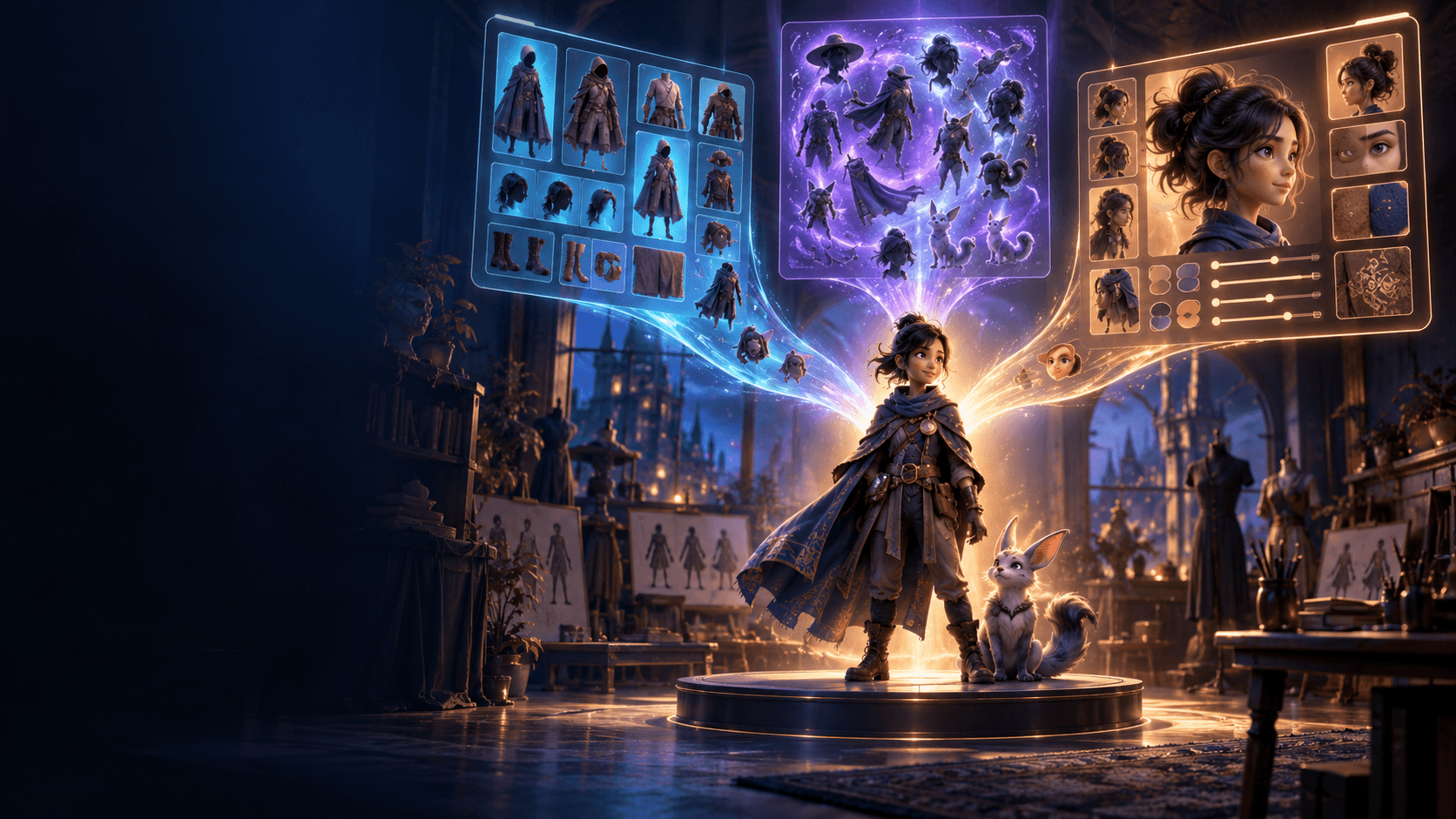
Keep a short block unchanged: “Same approved adult courier: narrow oval face, amber eyes, short auburn bob, moss-green waterproof coat, navy satchel, red seal pouch.” Put it before scene-specific action. Attach the approved character or reference through the current interface. Do not swap synonyms between shots. Add outfit changes as named variants, not casual prompt edits.
Camera Movement Prompts That Give Clear Direction
Use one move: locked shot, slow push-in, pull-back, lateral track, pan, tilt, arc or handheld follow. State the subject relationship: “camera tracks beside the bicycle” is clearer than “dynamic camera.” Add speed and endpoint. Avoid stacking “orbit, zoom, pan and crane” in a short clip. Controlled camera language improves AI video prompt adherence because the motion has a single priority.
Negative Prompts for AI Animation
Use exclusions that protect the shot: no extra people, no text, no costume change, no camera cut, no new prop, no transformation. Do not paste a giant generic negative list into every prompt. If the model keeps changing the face, strengthen the reference and simplify motion; the phrase “no bad face” does not specify the desired identity.
Prompt Troubleshooting by Symptom
Wrong face: return to the saved character and stable identity block. Wrong composition: fix the keyframe or framing language. Chaotic action: reduce to one verb and simpler camera. Style drift: remove conflicting style words. Melting hands: shorten the interaction or use an insert. Flat scene: revise the beat or light hierarchy. Slow sequence: edit first. This is the practical answer to “how to fix bad Elser AI prompts.”
Five Copy-Paste Elser AI Prompt Patterns
Character sheet: “Neutral full-body and portrait of [identity], clear outfit layers, simple background, even light.” Cinematic image: “[subject] in [setting], [shot size and placement], [light source], [emotion], no text.” Image-to-video: “[primary action], [secondary motion], [camera and speed], [duration], preserve [identity], no cut.” Storyboard: “Create [number] shots for [five beats], include purpose, framing, action and duration; preserve screen direction.” Anime dialogue shot: “[character] listens, then speaks one short line in a stable medium close-up; restrained mouth and eye movement; locked camera; preserve face and costume.” Replace brackets with visible decisions and remove any pattern that the current scene does not need. Save the exact successful prompt with its model and reference IDs.
Frequently Asked Questions
What is the best Elser AI image prompt structure?
Use subject, stable identity, setting, composition, lighting/style and a short list of protective exclusions.
How is an image-to-video prompt different?
The source image already defines appearance, so emphasize subject action, environmental movement, camera, timing and what must remain unchanged.
Should I use negative prompts for Elser AI video?
Use a concise list that protects the shot, such as no extra person, no text, no costume change or no camera cut.
How do I prompt consistent characters?
Reuse the saved character/reference and an unchanged identity block. Alter only scene state, action, framing and camera.
Why does adding more prompt detail sometimes make results worse?
Extra clauses can introduce competing actions, camera moves or styles. Diagnose the failed layer and revise only that instruction.
Conclusion
Better Elser prompts give one stage a clear job. Direct composition in images, change in video, identity through stable references and sequence through storyboards. When a result fails, diagnose first and add fewer, better instructions. Continue with Elser AI when you are ready to apply this exact workflow to a real project.