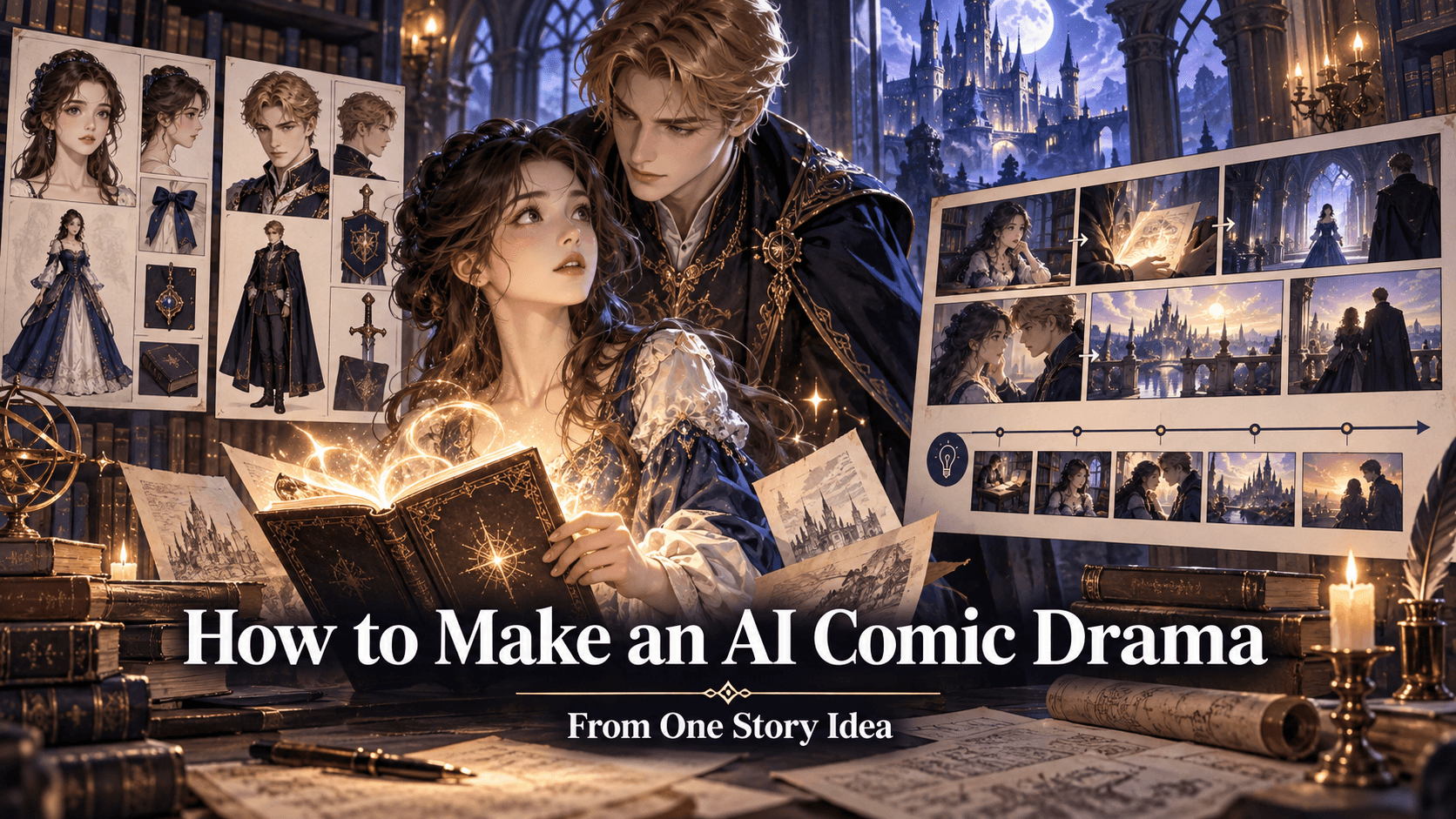
How to Create a Manga Franchise with AI: From One Character to a Story World People Want to Follow
Most AI manga projects start strong and fall apart fast.
The first character looks amazing. The first panel has atmosphere. The first trailer gets a few comments like “I’d watch this.” Then chapter two arrives, and the protagonist’s face has changed. Chapter three introduces a new power system that contradicts the first one. The trailer looks cool, but it does not feel connected to the comic. By the time the creator has twenty images, they do not have a franchise. They have a beautiful folder of unrelated experiments.
That is the real challenge of creating a manga franchise with AI.
The hard part is not generating art anymore. The hard part is building a world that can survive repetition. A franchise needs characters who remain recognizable, rules that stay consistent, conflicts that can produce more than one episode, and a workflow that turns the same creative assets into manga pages, animated shorts, TikTok teasers, music videos, character introductions, and eventually a recognizable IP.
AI can help enormously, but only if you stop using it like a slot machine.
Instead of asking for “a cool manga hero in a fantasy world,” you need to build a production system. That system should answer five questions before you generate too much content: Who is the story really about? What can happen again and again? What visual rules must never change? How will characters stay consistent across chapters and videos? And how will you turn the same world into multiple formats without losing its identity?
That is where an all-in-one creative platform like Elser AI becomes useful. Elser AI is not just for making one image or one clip. Its workflow can support AI character generation, manga and comic creation, storyboards, image-to-video animation, voice cloning, lip sync, music, sound effects, and video enhancement. For a manga franchise, that matters because the same character and world need to move across formats without being reinvented every time.
Start with the Franchise Engine, Not the First Chapter
A chapter is an event. A franchise is an engine.
This is where many creators go wrong. They spend hours designing the opening scene but never define the repeatable story loop. A manga franchise needs a premise that can keep producing situations.
A weak idea sounds like this:
A boy discovers he has powers and fights monsters.
That can become a chapter, but it does not yet tell us why readers should return.
A stronger franchise engine sounds like this:
A teenage courier delivers forbidden messages between human cities and spirit districts, but every delivery forces her to choose which side of a hidden war receives the truth.
Now we have a repeatable action, a world rule, a moral conflict, and room for episodic storytelling. Each chapter can feature a new delivery, a new district, a new secret, and a new consequence. The franchise can expand without losing its core.
Before opening any AI tool, write your franchise engine in one sentence:
This is a story about [main character] who repeatedly [core action] in a world where [unique rule], while struggling with [emotional conflict].
This sentence becomes the anchor for everything else. When you generate characters, locations, manga panels, trailers, or anime openings, the output should still point back to this engine. If it does not, it may be cool, but it probably belongs to another story.
Design the Main Character Like a Long-Term IP Asset
A manga protagonist needs more than beauty. They need recognizability.
That means the character should still be identifiable in a close-up, a full-body panel, a chibi sticker, a TikTok thumbnail, a black-and-white manga frame, and an animated trailer. If the design only works in one polished portrait, it is not ready for a franchise.
A strong AI manga character usually has three kinds of anchors.
The first is a silhouette anchor: hair shape, coat shape, hat, weapon, bag, wings, scarf, or posture. The second is a color or value anchor: a red ribbon, white jacket, dark gloves, silver hair, or black-and-gold uniform. The third is a story anchor: an object or visual detail that means something inside the plot.
For example, instead of designing “a cute anime girl with blue hair,” you might design:
A young memory courier with short silver hair, a dark green delivery coat, a cracked brass badge, fingerless gloves, and a red thread tied around her wrist because she is afraid of forgetting her own name.
That is already more franchise-ready. The red thread is not decoration. It is a story object. The brass badge can appear in close-ups. The coat creates a silhouette. The fear of forgetting connects the design to the emotional premise.
When using Elser AI, this is the point where you should create the character as a reusable asset, not just a one-off portrait. Generate a front view, three-quarter view, full-body view, expression sheet, and one clean reference image that will guide manga panels and videos later. This reduces one of the most common AI franchise problems: the character slowly becoming a different person every time the story moves to a new scene.
Build the World Rules Before You Build the Map
A franchise world does not need to be huge. It needs to be understandable.
Readers can accept almost any fictional rule if it is clear and consistent. They get frustrated when rules change randomly. AI can accidentally make this worse because it is very good at inventing new details. If you let every generation expand the world freely, your universe will become visually impressive but logically unstable.
So before generating locations, define three levels of world rules.
First, define the physical rule. What is different about this world? Maybe memories can become objects. Maybe cities disappear when no one speaks their names. Maybe music controls machines. Maybe shadows can be traded.
Second, define the social rule. How do people live with that difference? Are there guilds, schools, police units, black markets, religious groups, celebrities, outcasts, or rituals?
Third, define the personal rule. How does the main character suffer because of this world? A setting becomes emotionally useful only when it pressures the protagonist.
This matters for AI generation because prompts become sharper. Instead of asking for “a fantasy city,” you can ask for:
A crowded manga city where forgotten memories are sold as glowing paper charms, with street vendors, old archive towers, rain-soaked alleys, and delivery routes marked by red thread symbols.
That prompt contains world logic. It is not just aesthetic.
Create a Franchise Bible That AI Can Actually Use
A franchise bible should not be a giant document nobody reads. It should be a practical control panel for your story.
For an AI manga franchise, your bible should include the premise, main character descriptions, visual style rules, world rules, recurring locations, relationship dynamics, forbidden changes, and prompt language you reuse across generations.
The most important section is “do not change.”
For example:
Do not change the protagonist’s red thread bracelet.
Do not change the brass badge shape.
Do not make the memory spirits speak directly.
Do not turn the city into clean sci-fi; it should feel old, crowded, and handmade.
Do not replace the manga ink style with photorealistic rendering.
Do not make the protagonist cheerful in serious scenes; her humor is dry and defensive.
This is where depth comes in. Consistency is not just about faces. It is about rules, tone, behavior, props, and emotional logic.
Every time you use AI to generate a new chapter panel, scene, trailer, or voice line, pull from the bible. The bible is what stops your project from becoming nine different anime ideas wearing the same title.
Turn the Manga into a Multi-Format Franchise
A manga franchise in 2026 should not live in only one format.
The comic is the foundation, but discovery often happens through video. Readers may first encounter your world through a 15-second TikTok teaser, an AI anime opening, a talking character intro, a motion comic scene, or a short music video built around the protagonist.
This is where Elser AI fits naturally. You can use the same character references and story material to create manga panels, then storyboard a short animated trailer, generate image-to-video shots, add voice, sync dialogue, create background music, add sound effects, and export social-ready content.
A smart launch package could include:
A pilot manga chapter.
A 30-second vertical trailer.
Three character introduction videos.
One fake anime opening clip.
A motion-comic version of the strongest scene.
A short “world rule” explainer for TikTok or Shorts.
The key is that all of these assets should feel like they come from the same franchise. Same character anchors. Same visual language. Same world rules. Same emotional promise.
Do not use video just to show that the art can move. Use video to make the world easier to enter.
Final Takeaway
Creating a manga franchise with AI is not about generating as many images as possible. It is about creating a repeatable creative system.
Start with the franchise engine. Design the protagonist as a long-term IP asset. Define world rules that produce conflict. Build a usable franchise bible. Then turn your manga into trailers, anime shorts, voice scenes, music videos, and social clips without losing consistency.
AI gives independent creators studio-level leverage, but the direction still has to come from you. The more clearly you define your world, the more useful AI becomes.
Elser AI is built for this kind of connected workflow: characters, manga, storyboards, videos, voices, lip sync, music, sound effects, and finishing tools all support the same creative pipeline.
That is the difference between making a cool AI manga image and building a manga franchise people can actually follow.