How to Turn One Idea into a Complete Anime with Elser AI
One sentence can start an anime, but it cannot answer every production question. To become a complete short, the idea needs a protagonist, change, visible events, recurring design rules, shot coverage, sound and an ending.
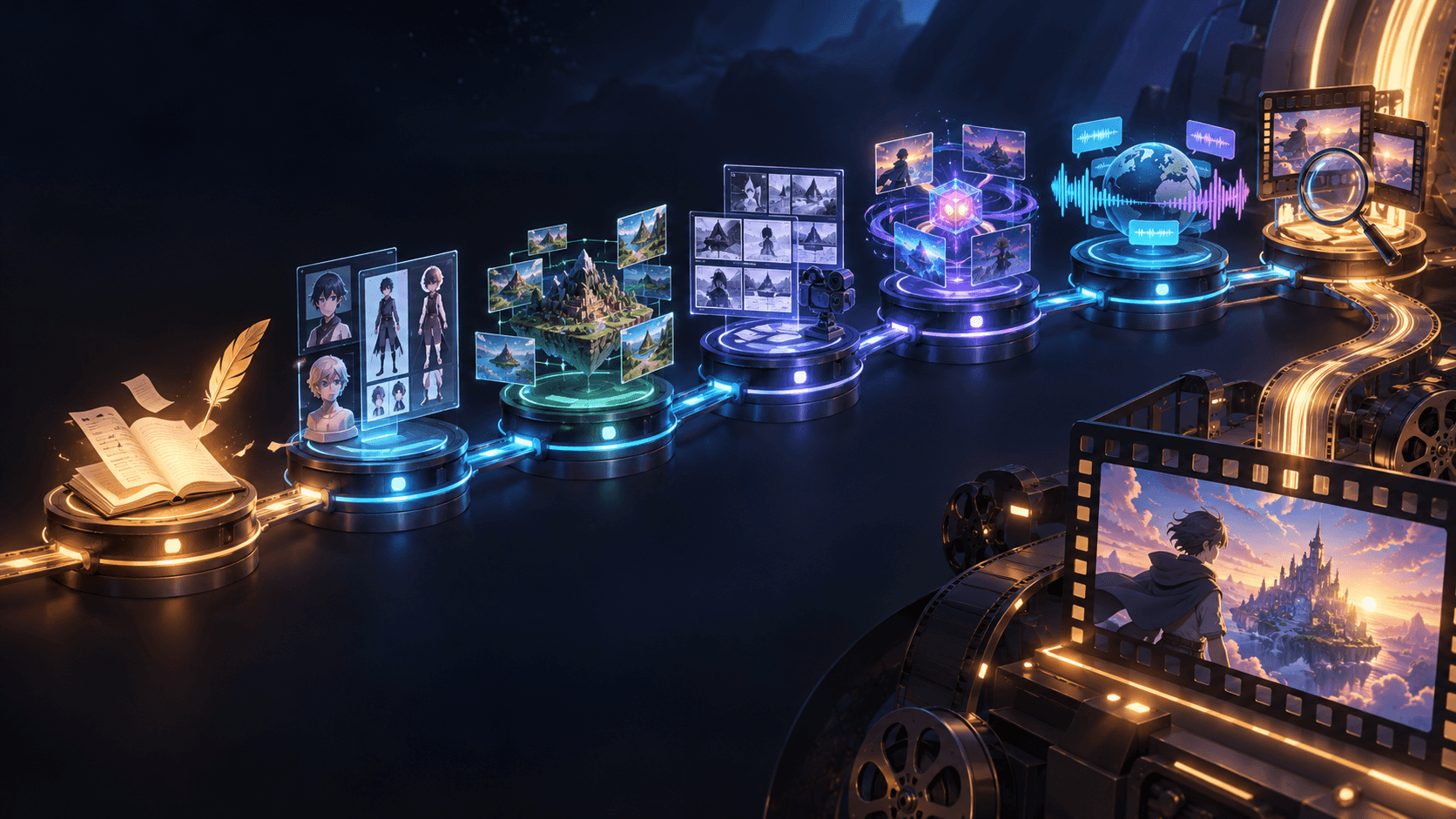
Elser AI's current movie workflow includes a beginner-oriented “Start from One Idea” path that expands a premise into editable scenes, followed by character setup, Auto Storyboard, Manual or Storyboard Studio, generation, audio, editing and export. The best results come from letting AI propose possibilities while you approve each irreversible choice.
This guide uses an example premise:
A shrine's smallest guardian discovers that the morning sun has been stolen.
Test Whether the Idea Has a Film Inside It
Ask six questions:
- Who acts?
- What do they want now?
- What prevents it?
- What can the audience see change?
- Why must it happen today?
- What final image proves the story is over?
For the guardian story:
- Actor: a palm-sized fox spirit.
- Goal: restore dawn before the village wakes.
- Obstacle: the sun is trapped inside a temple bell.
- Visible change: darkness becomes warm morning light.
- Urgency: the first train will cross a dangerous unlit bridge.
- Final image: sunlight catches the guardian's tiny bell collar.
This is enough to guide expansion without dictating every shot.
Enter a Creative Brief, Not a Vague Theme
In Elser AI's idea-starting route, provide format, runtime, protagonist, conflict, style and ending tone.
Create a 60-second fantasy anime short. A palm-sized fox shrine guardian learns that sunrise is trapped inside the temple bell and must release it before the first village train reaches a dark bridge. One shrine location, no crowd scenes, minimal dialogue, gentle suspense, warm ending, hand-painted anime backgrounds, consistent red scarf and brass collar bell.
The prompt gives the expansion boundaries. It does not prescribe every camera angle, so the story system can still contribute.
Try the premise before expanding scope: Start a new Elser AI anime/movie project, enter one production-sized idea and pause when the editable storyline appears.
Judge the Expanded Story by Causality
Do not approve an expansion because it sounds poetic. Read the scene list as cause and effect:
Because the sky remains dark, the guardian investigates. Because the bell glows, it climbs the tower. Because its collar resonates with the trapped sun, it risks striking the bell. Therefore dawn returns.
If scenes connect only with “and then,” strengthen motivation or remove them.
Use a compact story spine:
- Normal world.
- Disruption.
- First attempt.
- Complication.
- Decisive action.
- New image.
For a one-minute short, subplots and lore explanations usually weaken the central turn.
Convert the Expansion into Editable Scene Cards
At the storyline stage, give every scene four fields:
| Field | Question | | Objective | Why does this scene exist? | | Visible event | What changes on screen? | | New information | What does the viewer learn? | | Exit state | What must be true before the next scene? |
A scene that cannot answer these questions is likely atmosphere, repetition or undeveloped exposition. Atmosphere is valuable, but it should often be a shot inside a scene rather than a separate story unit.
Build the World by Repeating a Few Rules
“Complete anime” does not require a large world. It requires a coherent one.
Choose:
- one architecture language;
- one time-of-day progression;
- three dominant colors;
- one recurring environmental motion;
- one symbolic object;
- one rule for magic.
Example: dark indigo shrine, paper lantern geometry, blue-black and vermilion palette, drifting ash, circular bells, and magic visible only as warm reflected light. These rules give separate generations a shared visual logic.
Create the Protagonist as a Reusable Asset
Elser AI says created characters can be saved and reused across image, video and storytelling workflows. Define the guardian in fields:
- species and scale;
- face and ear shape;
- fur markings;
- scarf construction;
- bell size and attachment;
- movement style;
- neutral and extreme expressions;
- forbidden changes.
Generate a clean reference before scenes. If the design is difficult to reproduce at a distance, simplify it. A character's silhouette and two signature traits matter more than ornamental detail that changes between shots.
Choose the Storyboard Mode by the Question You Need Answered
Use Auto Storyboard to discover how the system interprets the scene. Use Manual when your scene split is approved. Use Storyboard Studio when composition, coverage and order are the primary creative work.
Do not treat modes as quality levels. They provide different amounts of control.
For the bell sequence, storyboard:
- shrine and dark village geography;
- guardian notices the silent bell;
- scarf catches on the rope;
- close-up of collar resonating;
- decisive pull;
- sunrise revealed across the bridge;
- quiet final reaction.
The climax needs setup, action and consequence. One frame cannot carry all three clearly.
Generate with a Visual Source of Truth
Approve keyframes before motion. Place them side by side and check:
- scale of the guardian relative to steps and bell;
- scarf length and collar design;
- shrine geography;
- position of rope and bell;
- direction and intensity of dawn light;
- continuity of ash or wind.
Image-to-video is useful when a key composition is already right. The still defines appearance; the motion prompt should describe the change.
Example:
The small fox guardian braces both paws and pulls the temple rope once; scarf and paper charms lift from the force; the brass bell swings slightly; low camera pushes toward the collar as it begins to glow; end before the bell rings. Preserve exact fur markings, red scarf, brass collar, shrine architecture and indigo night palette. No size change, no new characters, no camera orbit.
Build a Sequence, Not One Long Generation
Short clips are editorial building blocks. Generate clean units:
- establishing environment;
- character action;
- insert detail;
- reaction;
- effect or transformation;
- ending hold.
This makes failures replaceable. If the hand or paw interaction breaks, an insert plus sound may convey the event more convincingly than forcing another complex continuous shot.
Let Audio Reveal the World
Elser AI's public audio workflow includes voice, voice cloning, lip sync, music and sound effects. A mostly silent anime short can still feel rich:
- distant rail vibration establishes urgency;
- paper charms and wind define the shrine;
- the collar emits a small answering tone;
- the temple bell creates the climax;
- birds enter only after sunrise.
Use dialogue only if it changes interpretation. One line—“Just once. Wake up.”—may be enough. Match voice duration to the edited shot, and obtain permission for any cloned voice.
Edit Toward the Final Image
Assemble the entire rough cut before perfecting effects. Compare every shot with the promised ending. The sunrise should feel earned through visual progression: colder, darker frames early; warmer highlights appearing around the bell; full light only after the decisive action.
Trim anything that delays the central question without increasing tension. Hold the final image long enough for viewers to recognize the change. Use the same sound motif from the collar and temple bell to connect character and solution.
Scale the Idea Only After the Short Works
If the 60-second version succeeds, expansion options include:
- a longer setup explaining the guardian's insecurity;
- a second character at the bridge;
- a failed first attempt;
- more detailed world history;
- an episodic consequence.
Do not add these because the system can generate more scenes. Add them only when they deepen a tested story.
FAQ
Can Elser AI create anime from a single prompt?
Its current movie workflow supports starting from a short idea, expanding it into scenes and continuing through storyboards and video production. Review the expansion before rendering.
How detailed should the first idea be?
Include protagonist, immediate goal, obstacle, visible ending, runtime and basic style. Leave individual shots for the storyboard stage.
Does a complete anime need dialogue?
No. Clear action, reaction, sound and visual change can carry a short. Dialogue should add meaning rather than explain what viewers can see.
How do I stop idea expansion from becoming too large?
Set limits on runtime, characters, locations and subplots. Delete scenes that do not change the story state.
Can I reuse the same character in another project?
Elser AI's public page says saved characters can be reused across image, video and storytelling workflows. Maintain the same design specification and references.
Conclusion
One idea becomes a complete anime through controlled expansion. Define the film-sized premise, approve causal scenes, establish a small visual world, save the protagonist, storyboard the necessary coverage, animate approved keyframes and shape the final meaning in sound and edit.
AI can multiply options. Completion still comes from deciding which options belong to the same story.