How We Created a Viral AI Anime Short Series with Elser AI: A Complete Case Study
Creating an AI-generated anime video is easier than ever. Creating an AI anime series that audiences actually want to follow is an entirely different challenge.
Many creators discover that their first AI-generated episode looks impressive. The second episode is acceptable. By the third episode, the characters look different, the pacing falls apart, and viewers lose interest because nothing feels connected anymore.
We encountered exactly the same problem.
Our goal wasn't simply to generate beautiful animation. We wanted to create a short-form anime series that people would recognize after watching only a few seconds. That meant maintaining consistent characters, visual style, storytelling rhythm, and production quality while keeping the workflow efficient enough to publish new episodes every week.
Instead of chasing the latest AI model every month, we focused on building a production pipeline that could consistently deliver quality results.
This case study explains exactly how we approached that process, what worked, what failed, and how creators can apply the same principles to their own AI animation projects.
Why AI Anime Is Becoming One of the Fastest-Growing Creator Categories
Short-form video has changed how audiences consume animation.
Instead of watching twenty-minute episodes, millions of viewers now spend their time watching stories that last anywhere from thirty seconds to two minutes. Platforms like YouTube Shorts, TikTok, and Instagram Reels have created an environment where creators can build loyal audiences through serialized content rather than traditional long-form productions.
At the same time, AI video technology has matured rapidly.
Modern tools now assist with nearly every stage of production. GPT-5.6 significantly improves brainstorming, scripting, and dialogue refinement. Google's Veo has demonstrated increasingly realistic scene generation and cinematic camera movement. Runway continues expanding AI-assisted editing capabilities. Kling and Seedance have pushed forward motion quality and character consistency, helping creators produce smoother visual sequences.
These technologies dramatically lower production barriers, but they do not automatically solve the creative problems that make viewers return for another episode.
Successful AI anime still depends on storytelling.
Our objective was therefore never to produce the most technically impressive animation. We wanted to build a repeatable system capable of publishing entertaining episodes on a consistent schedule.
That distinction changed every decision we made.
Step One: Start With a Series Concept Instead of Individual Videos
Many creators begin by asking AI to generate a cool anime scene.
The result might look impressive, but it rarely becomes the foundation of a successful series.
Instead, we started with one simple question:
Why would someone watch Episode Two?
Before writing any prompts, we defined four core elements.
The first was the premise.
Our series revolved around a small cast of recurring characters placed in humorous everyday situations with unexpected endings. Every episode could stand alone while gradually reinforcing each character's personality.
Second, we defined our audience.
Rather than trying to appeal to everyone, we focused on viewers already interested in anime, comedy, and short-form storytelling.
Third, we established visual identity.
Color palette, environment, lighting style, clothing, and overall mood were documented before generating a single frame.
Finally, we decided on episode structure.
Every episode followed roughly the same rhythm:
- A strong opening hook within three seconds
- The main conflict introduced quickly
- Escalation through visual storytelling
- A memorable ending or cliffhanger
- A subtle reason to watch the next episode
This structure made scripting dramatically easier because every new idea fit into an established framework.
Step Two: Treat GPT-5.6 as Your Creative Writing Partner
One of the biggest misconceptions about AI filmmaking is that video generation is the most important step.
In practice, weak scripts produce weak videos regardless of which generation model you use.
We used GPT-5.6 primarily during pre-production rather than production itself.
Instead of asking for complete episodes, we collaborated on specific creative tasks.
For example:
- Brainstorming episode ideas
- Improving dialogue
- Tightening pacing
- Finding stronger opening hooks
- Simplifying exposition
- Making jokes land faster
Rather than accepting AI-generated scripts word for word, we treated them as first drafts.
Each revision focused on making dialogue feel more natural while removing unnecessary narration.
This process reduced production time considerably because stronger scripts required fewer visual revisions later.
A useful principle emerged early in the project:
The clearer the story, the fewer prompts needed to explain each scene.
Step Three: Build Character Sheets Before Writing Prompts
Character consistency remains one of the biggest challenges in AI-generated animation.
Even today's advanced models may change hairstyles, clothing details, facial features, or proportions between scenes if descriptions are inconsistent.
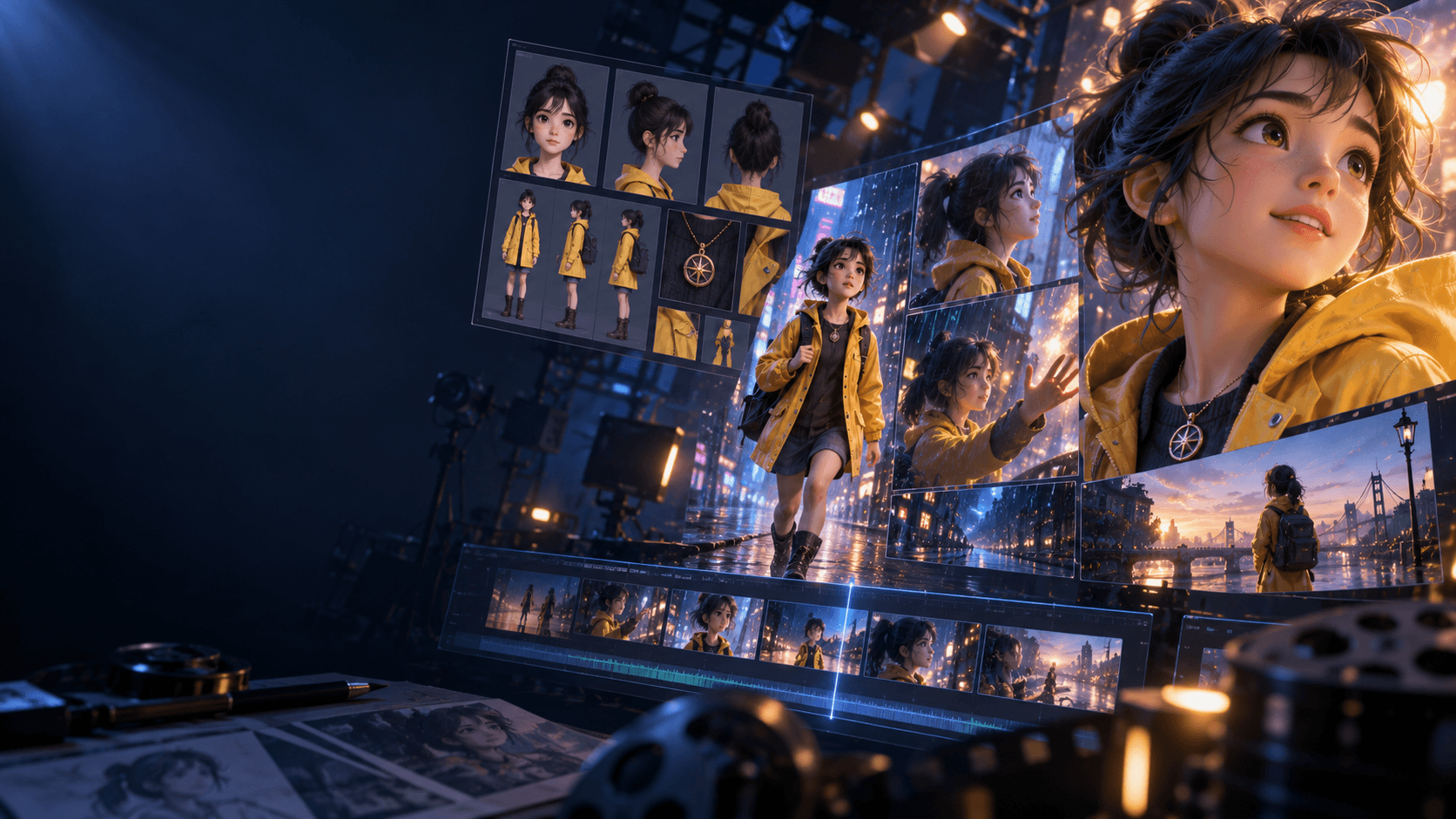
Instead of relying on memory, we created detailed character sheets.
Each sheet included:
- Age range
- Hairstyle
- Hair color
- Eye color
- Clothing
- Accessories
- Personality traits
- Facial expressions
- Typical poses
- Walking style
- Emotional reactions
Whenever a prompt referenced that character, these core attributes remained consistent.
Only the surrounding environment changed.
For example, instead of writing:
A teenage girl walking through town.
We consistently described:
A cheerful sixteen-year-old girl with shoulder-length black hair, amber eyes, a navy school jacket, white sneakers, and a yellow backpack walking confidently through a quiet shopping street during sunset.
Repeating these defining characteristics dramatically improved visual continuity across episodes.
It also reduced the number of regeneration cycles needed to achieve acceptable results.
Step Four: Plan Scenes Like a Film Director
One of our earliest mistakes was attempting to generate complete episodes in a single request.
The results were unpredictable.
Some scenes looked excellent.
Others felt rushed, inconsistent, or disconnected from the story.
We changed our workflow completely.
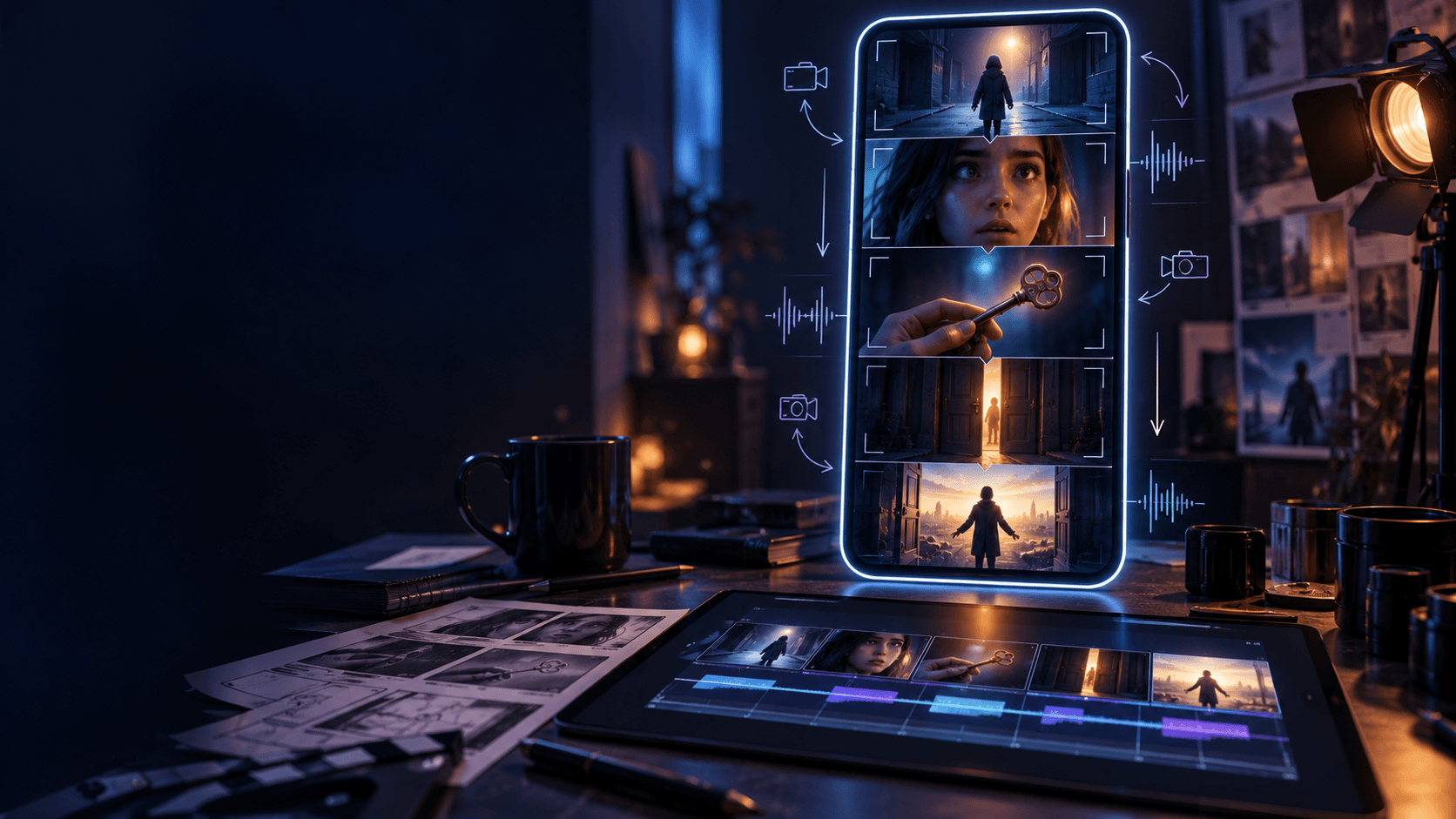
Every episode became a sequence of small scenes.
Each scene had one purpose.
For example:
Scene One introduced the setting.
Scene Two established the conflict.
Scene Three escalated tension.
Scene Four delivered the emotional payoff.
Instead of writing enormous prompts describing the entire episode, each scene received its own carefully written direction.
This modular workflow provided two major advantages.
First, individual scenes could be regenerated without affecting the rest of the project.
Second, pacing became much easier to control.
Professional filmmaking has always relied on scene-by-scene editing.
AI production benefits from exactly the same discipline.
Step Five: Prompt Less, Describe Better
When people first begin using AI video tools, they often assume that longer prompts automatically produce better results.
We discovered the opposite.
Early prompts looked something like this:
Create an incredibly beautiful cinematic anime masterpiece with amazing lighting, perfect details, ultra-realistic rendering, emotional atmosphere, dynamic movement, gorgeous colors, and dramatic camera angles.
The outputs were inconsistent.
Eventually we simplified everything.
Instead, every prompt followed a predictable structure.
Subject.
Environment.
Camera movement.
Lighting.
Emotion.
Composition.
For example:
Confident teenage student standing beside a railway crossing at sunset, medium shot, gentle camera push-in, warm golden lighting, quiet suburban neighborhood, hopeful expression, cinematic anime style.
This concise structure consistently produced more reliable generations than prompts overloaded with adjectives.
Specificity mattered.
Length did not.
Step Six: Use Studio Mode to Iterate Instead of Starting Over
One of the most valuable parts of our workflow was treating every episode as an evolving project rather than a finished generation.
Some scenes required multiple revisions.
Others worked perfectly on the first attempt.
Instead of rebuilding entire episodes every time one scene failed, Studio Mode allowed us to revise individual sections while preserving everything else.
That dramatically improved production efficiency.
Imagine an episode containing twelve scenes.
If Scene Eight contained awkward character movement, there was no reason to regenerate Scenes One through Seven.
Replacing only the problematic section saved both time and creative momentum.
Over multiple episodes, these small efficiency gains became significant.
The workflow also made collaboration easier.
Writers could revise scripts.
Editors could improve pacing.
Designers could refine prompts.
Everyone worked on different parts of the same production rather than waiting for complete regenerations.
Step Seven: Edit Like a Storyteller, Not a Technician
Many creators assume editing is mostly about fixing technical problems.
In reality, editing is where storytelling becomes clear.
Once every scene had been generated, we shifted our attention away from visual quality and toward audience experience.
We asked questions like:
- Does the opening immediately create curiosity?
- Is every scene moving the story forward?
- Are there unnecessary pauses?
- Does each shot reveal something new?
- Would a viewer still be watching after fifteen seconds?
Surprisingly, the biggest improvements often came from removing content rather than adding more.
Short-form audiences expect momentum.
A beautiful shot that doesn't advance the story becomes a distraction.
We also paid close attention to subtitles.
Many viewers consume short-form videos with the sound turned off, especially on mobile devices.
Well-timed subtitles improved accessibility while reinforcing important dialogue and jokes without overwhelming the screen.
Music selection also influenced pacing. Rather than treating background audio as decoration, we used it to support emotional transitions between scenes, ensuring that quieter moments felt intentional and energetic moments carried appropriate momentum.
The final edit was rarely about making the animation look more impressive. It was about making the entire episode easier—and more enjoyable—to watch.
Step Eight: Optimize Every Episode for the Platform, Not Just the Viewer
One lesson became obvious after publishing several episodes: a great video can still perform poorly if it's packaged incorrectly.
Many AI creators spend nearly all their time refining prompts and almost none thinking about distribution. In reality, publishing is part of the creative workflow.
Instead of exporting one version of each episode, we prepared multiple versions based on where the content would appear.
For YouTube Shorts, the opening three seconds had to immediately communicate the premise. Long fade-ins or slow establishing shots consistently underperformed.
For TikTok, pacing became even more aggressive. We shortened transitions, removed unnecessary pauses, and ensured that something visually interesting happened every few seconds.
Instagram Reels rewarded cleaner visuals and stronger captions, especially for audiences who discovered the content through recommendations rather than existing followers.
The video itself stayed largely the same.
The packaging changed.
For every episode, we optimized:
- Title
- Thumbnail
- Opening frame
- Caption
- Hashtags
- Description
- Call to action
Rather than writing clickbait titles, we focused on creating curiosity.
For example, compare these two approaches:
Episode 5
versus
She Thought It Was an Ordinary Cat… Until This Happened
The second title immediately raises a question that encourages viewers to keep watching.
Small changes like these consistently improved click-through rates without changing the underlying story.
What Didn't Work (And Why)
Every production teaches lessons.
Some of our biggest improvements came from mistakes rather than successful experiments.
Mistake 1: Constantly Switching Models
When a new AI model is released, creators naturally want to try it.
We made the same mistake.
One episode might use one workflow, while the next relied on an entirely different combination of tools.
The result wasn't innovation.
It was inconsistency.
Different models often interpret prompts differently. Even subtle changes in rendering style can make consecutive episodes feel disconnected.
Instead of chasing every new release, we eventually settled on a stable workflow and only introduced new tools when they solved a specific production problem.
Consistency proved more valuable than novelty.
Mistake 2: Overwriting Prompts
Our earliest prompts looked like miniature novels.
We described every object, every color, every camera angle, every emotion, and every possible detail.
Ironically, the AI often became less predictable.
As the project progressed, prompts became shorter and more intentional.
Instead of trying to control everything, we controlled the elements that mattered most:
- Character identity
- Environment
- Camera movement
- Lighting
- Emotional tone
Everything else became supporting detail.
This produced cleaner and more repeatable results.
Mistake 3: Chasing Perfect Generations
Another trap was believing the next generation would finally be "perfect."
Sometimes we regenerated the same scene ten or fifteen times.
Looking back, that was unnecessary.
Viewers rarely notice tiny imperfections that creators obsess over.
What they notice is whether the story keeps them engaged.
A scene that is 95% visually perfect but supports the narrative is almost always better than a technically flawless scene that slows the pacing.
Learning when to stop editing became just as important as learning how to improve prompts.
Mistake 4: Ignoring Analytics
Publishing isn't the finish line.
It's the beginning of the feedback loop.
Rather than focusing only on total views, we examined:
- Audience retention
- Average watch duration
- Drop-off points
- Completion rate
- Comments
- Shares
- Saves
Sometimes a visually stunning episode performed poorly because the opening failed to capture attention.
Other times, a relatively simple episode dramatically outperformed expectations because viewers connected with the story.
Analytics influenced our next script far more than our next prompt.
Why Elser AI Became the Center of Our Workflow
Throughout this project, we experimented with multiple AI tools.
Some excelled at writing.
Others generated impressive visuals.
Some focused on editing or camera motion.
The challenge wasn't finding powerful tools.
It was managing an increasingly fragmented workflow.
Switching between separate applications for scripting, planning, prompt management, scene revisions, subtitle editing, and exports introduced unnecessary complexity.
Files became difficult to organize.
Prompt versions were lost.
Scene revisions became harder to track.
That was where Elser AI made the biggest difference.
Instead of treating AI video generation as a single prompt followed by endless manual work, Elser AI helped organize the production process into a structured workflow.
Scripts, scenes, revisions, and exports remained connected throughout production.
For creators producing a single experimental video, this may not seem significant.
For anyone publishing weekly content—or building an ongoing series—it quickly becomes a major productivity advantage.
The more episodes we created, the more valuable workflow organization became.
The Biggest Lesson: Workflow Beats Individual Models
Many online discussions compare AI models as though one will permanently outperform every other option.
That isn't how professional production works.
Each generation of AI continues to improve.
GPT-5.6 has strengthened creative writing and planning.
Google's Veo continues advancing cinematic video generation.
Runway expands AI-assisted editing.
Kling demonstrates increasingly polished visual storytelling.
Seedance continues improving motion quality and consistency.
These developments benefit creators across the industry.
But after months of production, one conclusion became impossible to ignore:
Successful creators don't win because they use a different model.
They win because they use a better workflow.
A repeatable production system consistently outperforms random experimentation.
Instead of asking:
"Which AI model is the best?"
The more useful question becomes:
"Can I use this workflow every week without burning out?"
That shift in thinking transformed how we approached every project.
How You Can Apply This Workflow
If you're planning to create your own AI anime series, resist the temptation to begin with an ambitious ten-episode production.
Start with one episode.
Keep it short.
Focus on memorable characters rather than complicated plots.
Document your character descriptions before writing prompts.
Plan scenes individually instead of generating entire episodes.
Review every episode after publishing.
Identify what viewers responded to.
Improve one aspect with every new release.
Most importantly, remember that consistency matters far more than perfection.
Publishing ten good episodes will teach you considerably more than endlessly refining one "perfect" video that never reaches an audience.
Final Thoughts
AI has fundamentally changed what independent creators can accomplish.
Producing animated stories once required large teams, specialized software, and months of work. Today, a solo creator can move from an idea to a polished episode in a fraction of that time.
Yet the technology itself is only part of the equation.
Compelling AI anime still depends on clear storytelling, memorable characters, disciplined production, and a workflow that supports long-term creativity rather than one-off experiments.
Our experience showed that success didn't come from finding a magical prompt or relying on a single breakthrough model. It came from building a structured process that could be repeated, improved, and scaled over time.
If you're serious about creating recurring AI video content, invest as much energy in your workflow as you do in your prompts. Plan carefully, iterate intentionally, study your audience, and refine each new episode based on real feedback.
Platforms and models will continue to evolve throughout 2026 and beyond. The creators who thrive won't necessarily be the ones with access to the newest technology—they'll be the ones who consistently turn ideas into stories that audiences remember.
When your production process becomes organized instead of improvised, creating the next episode becomes faster, easier, and far more enjoyable. That's the real advantage of building with a workflow-first mindset, and it's why platforms like Elser AI are becoming an increasingly practical foundation for creators who want to produce AI animation consistently rather than occasionally.
Frequently Asked Questions
Is AI animation good enough for a recurring series?
Yes. Current AI video tools have improved significantly in visual quality and motion consistency. However, maintaining a recurring series still requires thoughtful prompt design, structured scene planning, and consistent character definitions.
How long does it take to produce one AI anime short?
For a 30–60 second episode, many creators can complete scripting, generation, revisions, and editing within several hours once they have an established workflow. Production becomes faster as prompt libraries and character assets are reused.
Should I use one AI model for everything?
Not necessarily. Different AI tools excel at different tasks, such as writing, video generation, or editing. Rather than searching for a single all-in-one solution, build a workflow that combines the strengths of multiple technologies while keeping your creative process organized.
Is Elser AI suitable for beginners?
Yes. Beginners can start with simple short-form projects, while more experienced creators can use features like Studio Mode to manage scene-by-scene production and iterate more efficiently as their projects become more complex.