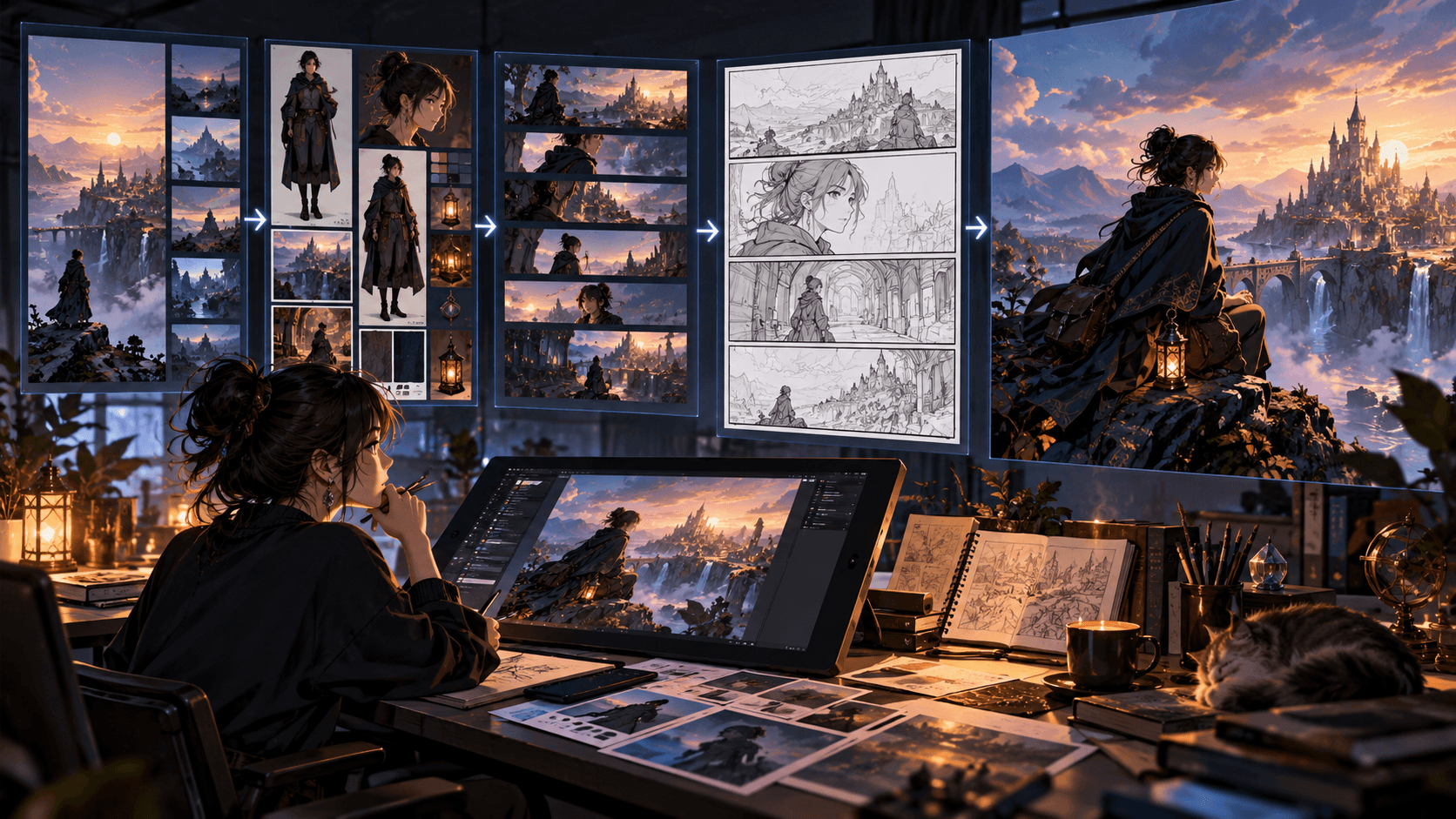
The Continuity Desk: Checking Wardrobe, Props, Scale, and Screen Direction
The fastest way to waste generations on character continuity checklist is to begin with style and postpone structure. This guide reverses that order and builds the continuity review for serialized visual work from explicit decisions. This article turns that goal into decisions, beginning with “Track wardrobe state, prop hand, damage, time of day, and character position by shot” and following it with “use screen-direction arrows on boards for entrances and exits.”
Translate the Goal: Track wardrobe state, prop hand, damage, time of day, and character
Track wardrobe state, prop hand, damage, time of day, and character position by shot. Treat this as a production constraint for “The Continuity Desk: Checking Wardrobe, Props, Scale, and Screen Direction,” not as optional polish. Without this constraint, the model or collaborator must invent missing information, and the invention is rarely consistent across a complete project. Apply it to one low-cost example of a continuity review for serialized visual work, then compare the result with the approved brief at full resolution.
Direct the Visible Detail: Record deliberate changes so reviewers do not 'correct' story
Record deliberate changes so reviewers do not 'correct' story information. This gives character continuity checklist a stable reference point when the next revision introduces new variables. Documenting the choice once prevents prompt drift, duplicated experiments, and late-stage corrections that cost more than the original generation. Apply it to one low-cost example of a continuity review for serialized visual work, then compare the result with the approved brief at full resolution.
Test the Edge Case: Use screen-direction arrows on boards for entrances and exits
Use screen-direction arrows on boards for entrances and exits. The rule matters at the moment the continuity review for serialized visual work is reviewed, not only while it is prompted. This decision also creates a useful review boundary: the team can reject a result for a named reason instead of debating whether it merely feels wrong. Change only this variable in the next test; keep references, framing, and other stable fields unchanged.
Prepare the Handoff: Perform continuity review on the sequence, not isolated frames
Perform continuity review on the sequence, not isolated frames. In character continuity checklist, this is a specification rather than a stylistic preference. The practical value appears at handoff, when another person can reproduce the intent without reconstructing it from chat history or filenames. Change only this variable in the next test; keep references, framing, and other stable fields unchanged.
What This Looks Like in Production
Consider an agency revising work after client feedback working on “The Continuity Desk: Checking Wardrobe, Props, Scale, and Screen Direction.” The required output is a continuity review for serialized visual work. The first attempt fails a concrete condition: record deliberate changes so reviewers do not 'correct' story information. The team saves the failed output because it reveals the cause. One controlled revision follows, and the next review asks whether the team did in fact perform continuity review on the sequence, not isolated frames. That comparison produces evidence about character continuity checklist; ten unrelated rerolls would produce only more files.
A Brief You Can Actually Use
The brief for “The Continuity Desk: Checking Wardrobe, Props, Scale, and Screen Direction” should be short enough to review beside the output. Populate these fields with evidence from the current continuity review for serialized visual work:
Scene purpose: produce a continuity review for serialized visual work
Canonical facts: Track wardrobe state, prop hand, damage, time of day, and character position by shot
Permitted variation: Use screen-direction arrows on boards for entrances and exits
Failure signal: Perform continuity review on the sequence, not isolated frames
Release state: continuity review for serialized visual work reviewer
Review Checklist
- Show where the continuity review for serialized visual work satisfies this requirement: Track wardrobe state, prop hand, damage, time of day, and character position by shot.
- Compare the changed version with a baseline that still uses the same approved character continuity checklist inputs.
- Mark the exact frame, layer, field, or file that proves: Record deliberate changes so reviewers do not 'correct' story information.
- Confirm the handoff owner can apply this rule without extra explanation: Perform continuity review on the sequence, not isolated frames.
Where Elser AI and ElserStudio Fit
For “The Continuity Desk: Checking Wardrobe, Props, Scale, and Screen Direction,” a creator may test the focused character continuity checklist step in Elser AI after registering. If a continuity review for serialized visual work grows into a multi-shot production with scripts, World assets, review states, and composition, it can move to ElserStudio. Choose the product after defining the artifact and continuity burden, not before.
Questions Creators Ask
What must be decided first for “The Continuity Desk: Checking Wardrobe, Props, Scale, and Screen Direction”?
Decide what a reviewer must be able to observe without reading the creator’s mind. In this case, the first acceptance condition is clear: Track wardrobe state, prop hand, damage, time of day, and character position by shot. Record the chosen reference, owner, destination, and version beside that decision.
What is the cheapest useful test for this character continuity checklist workflow?
Build one low-cost continuity review for serialized visual work that isolates the uncertain variable. Hold the source and all approved settings steady, then apply this topic-specific control: Use screen-direction arrows on boards for entrances and exits. Save both attempts and annotate the difference.
What evidence shows that the continuity review for serialized visual work can move forward?
An independent reviewer should be able to reproduce the decision from the handoff package. The decisive evidence for this article is that the team can show it followed this rule: Perform continuity review on the sequence, not isolated frames. The package should also retain the approved file, source links, version, and editable elements.
Final Takeaway
Finish “The Continuity Desk: Checking Wardrobe, Props, Scale, and Screen Direction” with two records: the accepted output and the reason it passed. That pairing makes the next revision faster, keeps collaborators aligned, and prevents an attractive mistake from becoming a production dependency.