How to Create an AI Video Shot List from a Story or Novel
A strong AI video rarely begins with a giant prompt. It begins with a small decision: what should the audience see next?
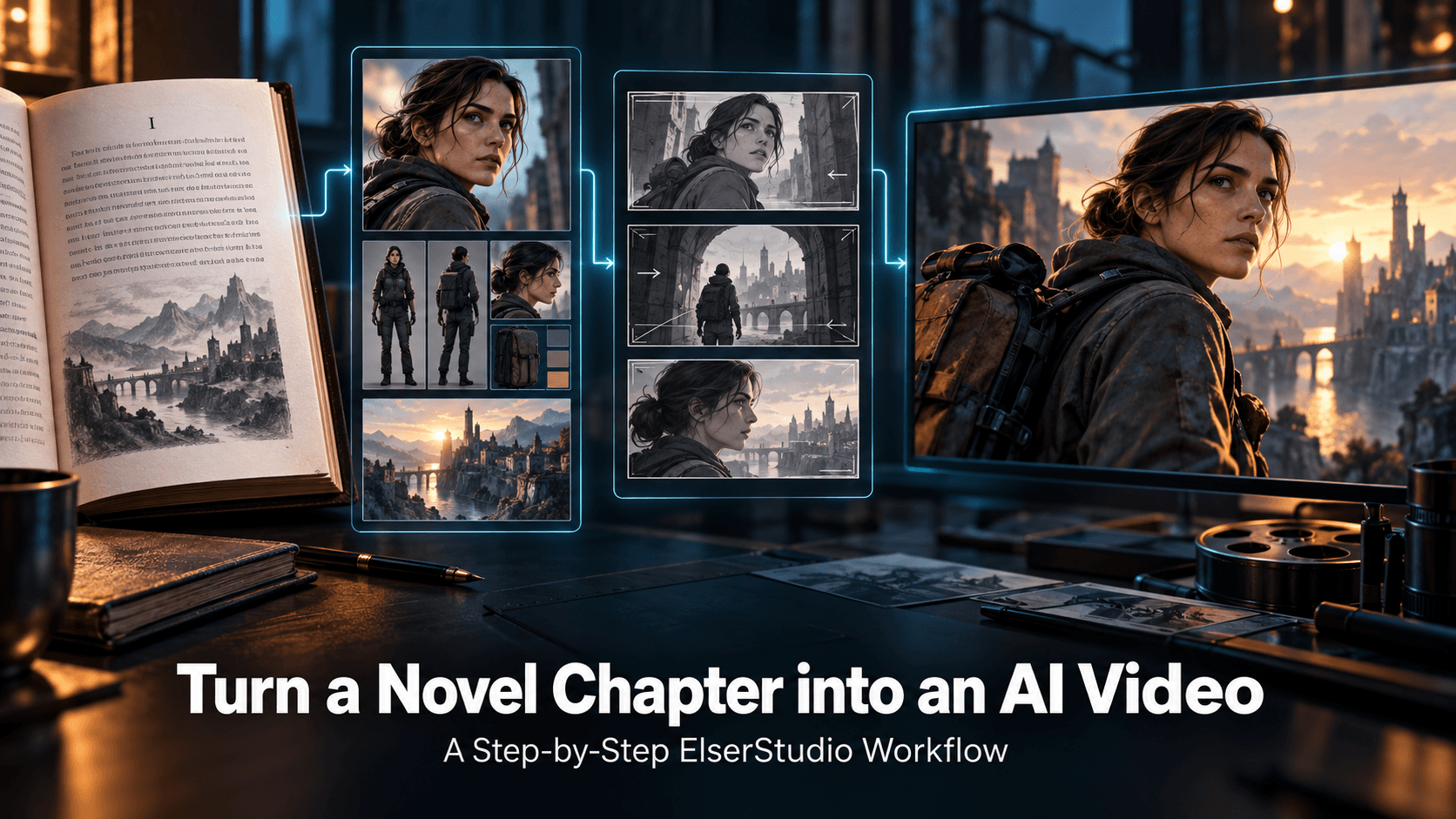
A shot list turns a story into those decisions. It identifies the images and actions required to carry the plot, then gives each generated clip a clear purpose. Inside ElserStudio, that shot list can sit beside the original story, recurring assets, video takes, and final composition instead of disappearing into a spreadsheet.
Let’s build one from a simple scene.
Find the story change first
Suppose the story says:
Nia returned to her father’s workshop after ten years. Everything was covered in dust except the clock on his desk. Its hands were moving backward. A wet footprint led toward the rear door.
The important change is not simply that Nia enters a workshop. She discovers evidence that someone has been there recently.
Break that change into visual beats:
- Nia returns to the abandoned workshop.
- She notices the moving clock.
- She finds the fresh footprint.
- She decides to follow it.
Those beats are the spine of the shot list.
Give every shot one reason to exist
A useful shot record includes:
- story purpose — what the audience learns;
- subject — who or what appears;
- action — what changes during the shot;
- framing — what needs to be visible;
- continuity — which approved assets and states must match;
- ending — how the shot hands attention to the next one.
For Nia’s scene, the list might look like this:
| Shot | Purpose | Action | End point |
| 1 | Establish return | Nia opens the workshop door and steps inside | She looks toward the desk | | 2 | Reveal the anomaly | The clock’s second hand moves backward | Ticking suddenly stops | | 3 | Show new evidence | Nia crouches beside a wet footprint | Her eyes follow it toward the rear door | | 4 | Create forward momentum | Nia approaches the rear door | Her hand reaches for the handle |
Notice that each shot is simple enough to review. If shot two does not show backward motion, it has failed even if it looks beautiful.
Build the list from your story inside ElserStudio
In ElserStudio, begin by pasting or importing the source material. The Story Script workflow can identify characters, locations, props, dialogue, and proposed shots, giving you an editable starting point on the canvas.
Read the generated shot table as a director. Remove redundant shots, split complicated actions, and add any beat the adaptation missed. The goal is not to accept the most shots. It is to keep the fewest shots that make the scene clear.
For example, “Nia enters, remembers her childhood, notices the clock, discovers the footprint, runs outside, and calls her sister” is not one useful shot. It contains a sequence. Break it into visible moments and leave internal memory on the page unless it changes the screen action.
Create the references before writing elaborate prompts
Prepare the recurring character, location, and prop assets inside the project World.
Nia needs an approved appearance and outfit. The workshop needs a consistent layout. The clock needs a design the audience can recognize again. If the rear door is on the right side of the room in shot one, the later approach should respect that geography.
These World assets can be attached directly to shots. That separation is valuable: the asset explains who or what something is, while the shot explains what it does now.
You no longer need to rewrite Nia’s entire appearance every time. Instead, the shot can focus on performance and camera direction: “Nia pauses inside the doorway, brushes dust from the desk, then looks toward the clock.”
Write actions with a beginning and an end
Video prompts become easier to judge when they describe a transition.
Instead of:
Cinematic mysterious workshop, Nia feels suspicious.
Try:
Medium shot. Nia enters the dusty workshop and stops beside the desk. She hears a slow ticking sound, turns toward the clock, and holds her gaze on it.
The second version gives the shot a starting position, an action, and an end state. You can add lighting, camera motion, and style, but those choices should support the narrative job rather than replace it.
If framing is especially important, create or attach a guide board. ElserStudio can combine the guide with the canonical character, location, and prop references so the generation has both visual context and motion direction.
Generate by risk, not necessarily by story order
The hardest shot may be number three, where Nia must remain recognizable while interacting with a small visual clue. Test that before generating ten easy establishing shots.
ElserStudio lets you prepare several shots, create video nodes, and follow the resulting tasks on the same canvas. Generate a small batch only after the references are stable. Then compare each take with the shot’s stated purpose.
Ask:
- Is the required information visible?
- Does the character match the approved asset?
- Is the prop in the correct state?
- Does the clip end at a usable cut point?
- Can the next shot begin naturally?
These questions are more useful than “Does this look cinematic?”
Move approved shots into the Composition timeline
The shot list becomes real when you watch the clips together. Connect the chosen video nodes to a Composition node and arrange them on the local timeline.
You may discover that shot two is too long, shot three needs a clearer insert, or the sound of the clock should begin before the cut. That is normal. The edit reveals relationships that individual previews cannot.
Update the shot list as you work. Mark accepted takes and record continuity changes. If Nia opens the rear door at the end of the scene, later shots should use the open-door state unless the story closes it.
Want to turn your own story into an editable shot plan? Download ElserStudio and build your first sequence on the local canvas.
FAQ
What is the difference between a shot list and a prompt list?
A shot list explains the story purpose, action, continuity, and edit relationship. A prompt tells a model how to create one piece of media. The shot list should remain useful even if you change providers.
Does every shot need a storyboard image?
No. Use a guide board when composition, blocking, or camera motion needs visual clarification. A clear written shot and reliable references may be enough for simpler moments.
How many actions should one AI video shot contain?
Usually one main action or closely connected action beat. Complex sequences are easier to direct and review when divided into several shots.
Can ElserStudio generate several shots together?
Yes. Prepared shots can be submitted in batches through the configured provider, with task progress and results kept visible. Stabilize references before scaling the batch.
Why include an end point for every shot?
The end point gives the editor a clean transition into the next clip and prevents the generation from wandering after the important action.
Conclusion
An AI video shot list is where a story becomes producible. ElserStudio turns that list into a living part of the project: the source story, reusable references, generated takes, and final edit remain connected on the same canvas. That makes every generation easier to direct—and much easier to use.