Can AI Turn a Novel into a Movie? What’s Possible—and What Still Takes Work
AI can now help a writer move from a novel to a real video sequence. It can organize a chapter into scenes, create character and location references, generate individual shots, and help assemble those shots into a cut.
What it cannot reliably do is swallow an entire novel and return a finished two-hour movie that understands every relationship, remembers every costume, and makes every editorial decision correctly.
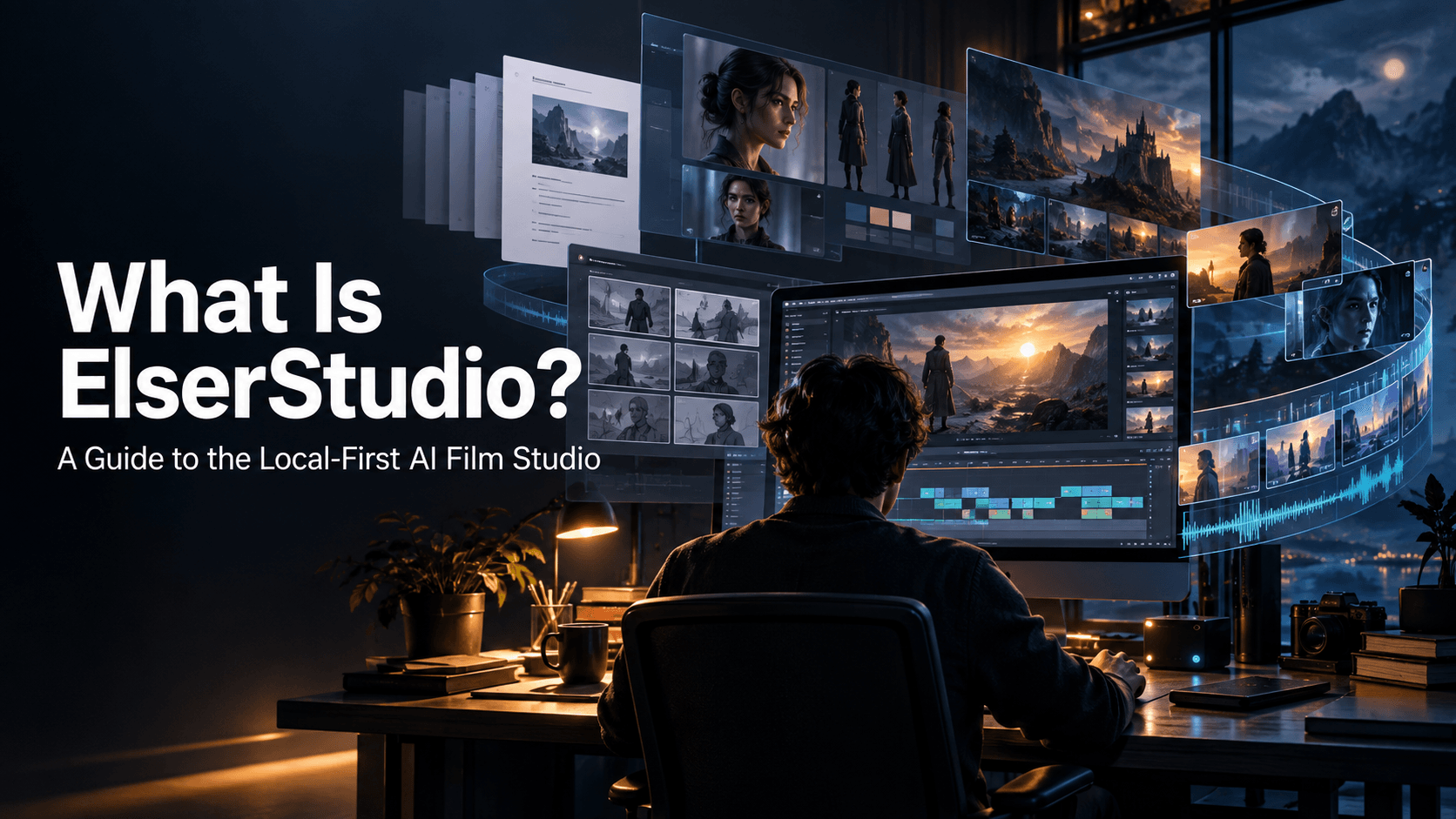
The exciting answer is therefore not “one prompt makes a movie.” It is that creators now have a much more accessible production process—and ElserStudio is designed to keep that process together on a local desktop canvas.
What AI can do with a novel today
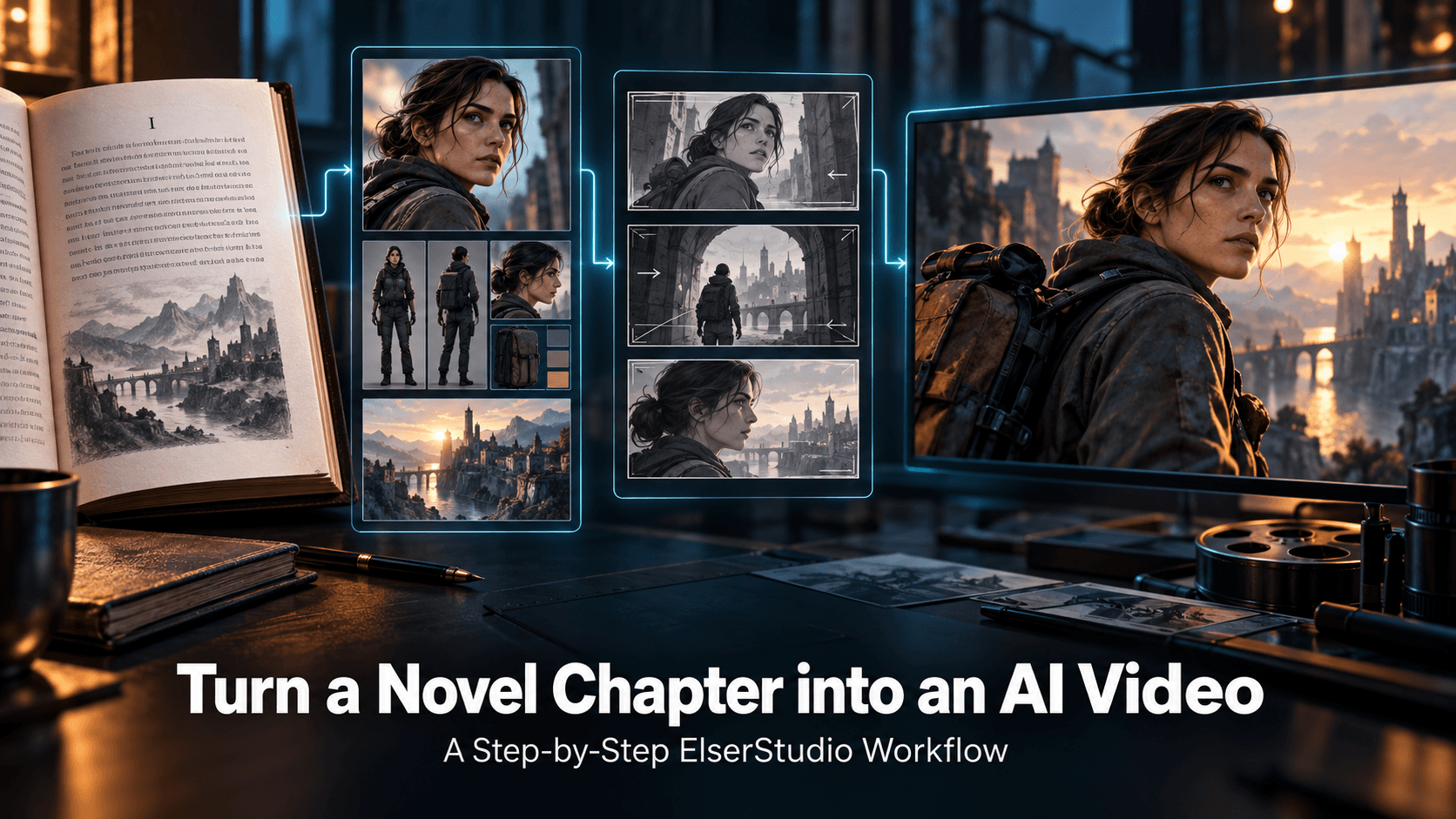
Begin with a scene rather than the whole book. In ElserStudio, you can paste prose or import TXT, Markdown, and PDF files. The source can become an editable script with characters, locations, props, dialogue, and proposed shots.
From there, AI can help you:
- identify visual scenes and story beats;
- prepare character sheets and location references;
- turn story actions into individual shots;
- create guide images or storyboards;
- generate video through a configured provider;
- compare takes and regenerate individual shots;
- place approved clips on a local composition timeline.
That is already a major change for writers. You can develop a visual proof of concept without first building a traditional studio pipeline from scratch.
The novel still needs to become a screen story
A novel tells us what a character thinks. A movie must decide what the audience sees and hears.
Consider this sentence:
Elena understood that her brother had never intended to return.
The sentence works on the page. For the screen, you need evidence. Perhaps Elena finds his empty passport case and a note addressed to someone else. Perhaps she sees that he has taken the family photograph he once promised never to move. The realization becomes an action, image, sound, or performance.
ElserStudio can help organize the script and shots, but you still decide which detail carries the emotion. That is not a limitation unique to AI; it is the work of adaptation.
Character consistency is a production task
A movie needs the same protagonist in many places and moods. In ElserStudio, recurring characters, locations, props, and voices can live inside a World. Each asset can have a canonical reference, description, and base prompt. Shots point back to those assets rather than reinventing them every time.
This is much closer to a film workflow than keeping a collection of unrelated prompts. If Elena appears in a kitchen, a train station, and a childhood flashback, the project still knows which character asset those shots share.
Generated results can vary, so you review each take on the canvas. If the face drifts or the coat changes, revise that shot while keeping the rest of the sequence intact.
Movies are made shot by shot
Current generative-video systems are strongest at producing relatively short clips. A longer film therefore emerges from many planned, generated, reviewed, and edited shots.
ElserStudio gives each shot its own place in the project. You can connect the characters and locations it needs, describe the action, set composition and duration, add sound direction, and optionally use a guide board. Completed videos remain attached to their production context.
This matters because a beautiful clip is not automatically a useful shot. The shot must reveal information, create an emotion, or move the story toward the next moment.
A realistic first movie project
Choose a scene that contains a small but complete change. For example:
- Elena enters her brother’s apartment.
- She finds the empty passport case.
- She notices the missing photograph.
- She decides not to call the police.
Prepare the apartment, Elena, the case, and the photograph as reusable assets. Create four focused shots. Generate two or three representative takes first, then assemble them in a Composition node.
When you watch the cut, ask whether someone who has not read the novel understands what Elena found and why it matters. If not, adjust the adaptation or add one clarifying shot. Do not hide a story problem beneath more visual effects.
Where local-first fits into the workflow
ElserStudio keeps project records, canvas organization, assets, and editing on your computer. AI generation still requires a connected provider; local-first does not mean every model runs offline.
For creators working with a long unpublished manuscript, that distinction is worth understanding. Review the terms of any generation provider you configure. ElserStudio also offers a local BYOK route in addition to its cloud setup, giving creators more choice over how generation is connected.
What still needs human direction
AI does not know which interpretation of a scene is emotionally correct. It cannot guarantee continuity, clear dialogue, release rights, or a good final pace. You still need to:
- choose what the adaptation keeps or removes;
- approve character and location designs;
- direct performance and camera intent;
- reject unusable takes;
- edit for story and rhythm;
- confirm rights for the novel, voices, images, and music.
The product becomes useful because it keeps those decisions visible and connected instead of pretending they no longer exist.
If you own a story you want to see on screen, download ElserStudio and begin with one short, complete scene.
FAQ
Can AI automatically make a feature film from a novel?
Not reliably as a one-step process. AI can assist across script breakdown, visual development, shot generation, sound, and editing, but a coherent feature still requires extensive human production work.
Is ElserStudio only a video generator?
No. It is a desktop production workspace connecting the source story, script, reusable assets, shot generation, review, and composition.
Should I start with a trailer or a scene?
A self-contained scene is often more informative because it tests whether the story remains understandable across several connected shots. A trailer is useful when your goal is primarily a pitch.
Can ElserStudio keep characters consistent?
It lets shots reuse the same canonical character assets and references, which supports consistency. Every generated take still needs review because model output can vary.
Can I adapt any novel I find online?
No. Use work you wrote, licensed material, or another source you have the legal right to adapt.
Conclusion
AI can help turn a novel into a movie, but it does so by supporting a real production process—not by removing one. ElserStudio gives writers a local place to move from manuscript to script, world, shots, video, and edit. Start with one scene that matters, finish it, and let that result guide the larger adaptation.