How to Turn a Chinese Fantasy Story into an Animated Comic Drama with Elser AI
Elser AI supports anime, comic and Wuxia-oriented visual storytelling, but “Chinese fantasy” is not a complete prompt. Before entering the platform, define whether the story is wuxia, xianxia, zhiguai-inspired, historical fantasy or an original xuanhuan world. Then use Elser’s connected workflow to preserve those decisions from script to export.
Prepare an Elser-Ready Adaptation Brief
This example follows an original junior exorcist who learns that a village “monster” preserves memories residents chose to erase.
Create four blocks:
STORY: The exorcist must decide whether to destroy the spirit or restore a painful truth.
SETTING: Original riverside village inspired by late-imperial material culture; not a named historical town.
VISUAL RULE: Human spaces use warm lantern light; spirit evidence appears as ash moving against wind.
PROHIBITED: random pseudo-Chinese writing, mixed Japanese shrine imagery, European armor, existing franchise designs.
Confirm rights to the story, translation and reference art. Traditional material may be reusable, but modern adaptations contain protected expression.
Choose the Correct Elser Entry Point
Use Follow Your Script when adapting an approved story. Use Start from One Idea only when the premise still needs development.
Script-led input:
SCENE 1 — Village shrine — dusk
The exorcist finds her mother's memorial tablet polished blank.

SCENE 2 — River steps
Ash from her lantern moves upstream toward a shadow under the bridge.

SCENE 3 — Spirit encounter
The spirit returns one erased promise and asks what the village should remember.
At Elser’s Storyline stage, edit scenes so every internal thought has a visible or audible equivalent.
Create a project in Elser AI and import one short arc. Approve the adaptation before selecting a visual model.
Configure Style and Cultural Boundaries
In Settings, choose aspect ratio, model, shot duration, voice direction and a visual style such as Wuxia or Anime & Film where appropriate. Add a concise project style card to scene notes:
- gray brick, dark timber, unglazed pottery and indigo cloth;
- warm lantern interiors and cyan-gray spirit exteriors;
- grounded fabric movement;
- exact calligraphy added separately when required;
- no decorative symbols without meaning.
Test one village exterior and one character close-up before producing all scenes. A model/style combination that makes a beautiful portrait may mishandle architecture.
Create Reusable Cast in Character Settings
Build the exorcist as an original character:
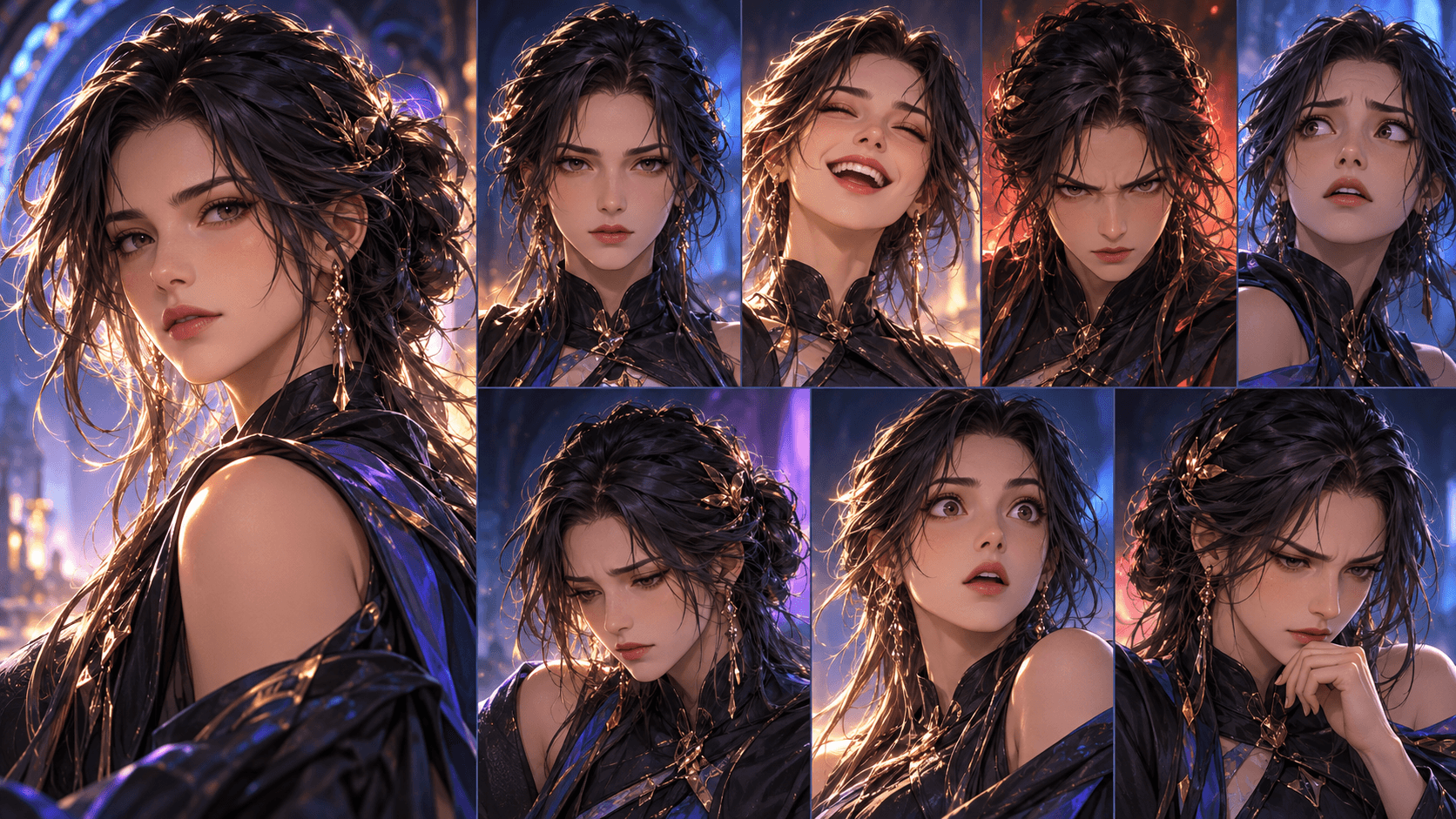
Young adult village exorcist, oval face, dark almond eyes,
long black hair in practical braided bun, layered indigo travel robe,
weathered leather satchel, plain violet spirit lantern,
observant, restrained gestures, no ornate court costume.
Save the approved asset. Create the spirit as a separate character with a stable silhouette and material logic. Avoid using appearance alone as a cultural label.
Direct the Storyboard in Elser
Auto Storyboard can reveal how Elser interprets the script. Use Manual to preserve the adaptation structure or Storyboard Studio for closer framing.
Create panels for village geography, blank memorial insert, ash direction, exorcist reaction, spirit reveal and restored inscription. Add the exact inscription in post if necessary. Dialogue scenes should show rank and relationship through blocking, thresholds and objects—not only talking heads.
Generate Motion That Serves the Motif
Use approved exorcist and river-steps frame.
She raises the violet lantern slowly.
Ash travels upstream against a light breeze and gathers beneath the bridge.
Her robe and hair move naturally; camera remains static; four seconds.
Keep architecture and costume unchanged.
Use movement in fabric, water, ash and light to express invisible force. Break martial action into geography, anticipation, impact and consequence.
Build Voice, Music and Final Cut
Assemble the rough cut in Elser before final performance. Direct voice by relationship and restraint. Add river ambience, wood, cloth, distant festival drums and the lantern’s sonic motif. Music should support the choice, not flatten cultural specificity into a generic “Asian” cue.
In Final Cut, refine scenes, transitions, subtitles and timing. Review Chinese text and translation with fluent readers, then export.
Translate Cultural Meaning into Production Constraints
“Chinese fantasy style” is too broad for a dependable output. Name the story's period inspiration, social order, architecture, textile logic, weapon tradition and supernatural grammar. A xianxia sect, a Tang-inspired court mystery and a southern folk-horror village should not share one generic costume set. Use references you have the right to use, and distinguish researched historical elements from intentional fantasy invention.
In Elser Settings and scene prompts, write positive constraints first and exclusions second:
Moonlit mountain archive inspired by timber-frame halls, gray tile roofs and restrained ink-blue lacquer. Disciple in crossed-collar indigo robe with narrow sleeves, cloth boots and a plain jade tally. Paper records, oil lamps and bamboo blinds. No European castle, modern glass, neon signage or plate armor.
This gives the generator coherent design relationships rather than a pile of decorative keywords.
Adapt Names, Titles and Exposition for Speech
Chinese fantasy prose often carries genealogy, ranks, courtesy names and institutional history in compact narration. A spoken scene cannot hold all of it. Decide what the viewer needs now. Introduce one formal title through behavior—who bows, who interrupts, who sits higher—instead of explaining the whole hierarchy.
Maintain a pronunciation sheet for character and place names before recording. In Elser's voiceover stage, review pacing and names separately from emotional performance. If an English-language adaptation retains terms such as shifu, dantian or jianghu, establish their meaning through context and use them consistently. Do not alternate translations casually.
Build a Motif System Across Elser Stages
Choose two or three recurring motifs with narrative jobs. A cracked jade tally can mark disputed authority; migrating cranes can signal exile; a red umbrella can identify the assassin before the face appears. Put the motif in Character Settings when it belongs to a person, in Storyline state when ownership changes, and in the storyboard when its placement carries meaning.
For motion, keep the motif stable:
Slow lateral camera move along the archive shelves. Shen Rui enters, places the cracked jade tally under the lamp, and withdraws his hand. The tally remains centered and unchanged; the red cord falls to the right. Preserve robe layers and hall architecture. No magical glow.
Review Action for Spatial and Cultural Coherence
For swordplay or magic, design a readable exchange: intention, technique, counter, consequence. Avoid mixing unrelated martial vocabularies simply because they look spectacular. If a talisman requires a hand seal and spoken phrase, keep that cause visible before the effect. Storyboard Studio can preserve the direction of travel, position of witnesses and ownership of artifacts.
Review the rough cut with a subject-aware reader when historical or regional claims matter. E-E-A-T in this context means being clear about sources, rights and invention—not presenting fantasy choices as historical fact.
Elser Adaptation Checklist
- The entry mode matches the source: Follow Your Script for a prepared adaptation, idea mode for exploration.
- Settings define format, style and shot behavior before generation.
- Character assets use coherent clothing, hair and social markers.
- Proper names and titles are pronounced consistently.
- Motifs retain form and ownership across shots.
- Storyboard action follows established geography and magic rules.
- Final Cut removes redundant lore while preserving necessary cause.
Use Elser AI to test one dialogue scene and one supernatural action scene before committing to an episode. Together they reveal whether the chosen visual language can carry both culture and story.
Document Sources and Creative Choices
Keep a short note separating historical references, genre conventions and original inventions. Record the source for a specific garment or ritual when accuracy is part of the claim, and label composite fantasy elements as design choices. This makes later review faster and prevents promotional copy from presenting an invented world as documentary history. Store licensed reference details alongside the Elser project so a recurring asset remains traceable across the series.
FAQ
Does Elser AI offer Wuxia-style comic creation?
The current Comic Generator page lists Wuxia among available style directions, while the movie workflow supports broader animation production.
Should I use Auto Storyboard?
Use it for a fast interpretation. Use Manual or Storyboard Studio when adaptation fidelity and cultural details require closer control.
Can I adapt an online novel I did not write?
Only with appropriate rights or permission. Public access is not adaptation permission.
Conclusion
Elser AI can connect a Chinese fantasy adaptation from approved script to Cast, Storyboard, motion, sound and Final Cut. The creator must still define the tradition, research details and protect rights. Build one culturally coherent pilot in Elser AI before expanding the world.