How to Use Grok AI Video Generator: Text-to-Video and Image-to-Video Guide
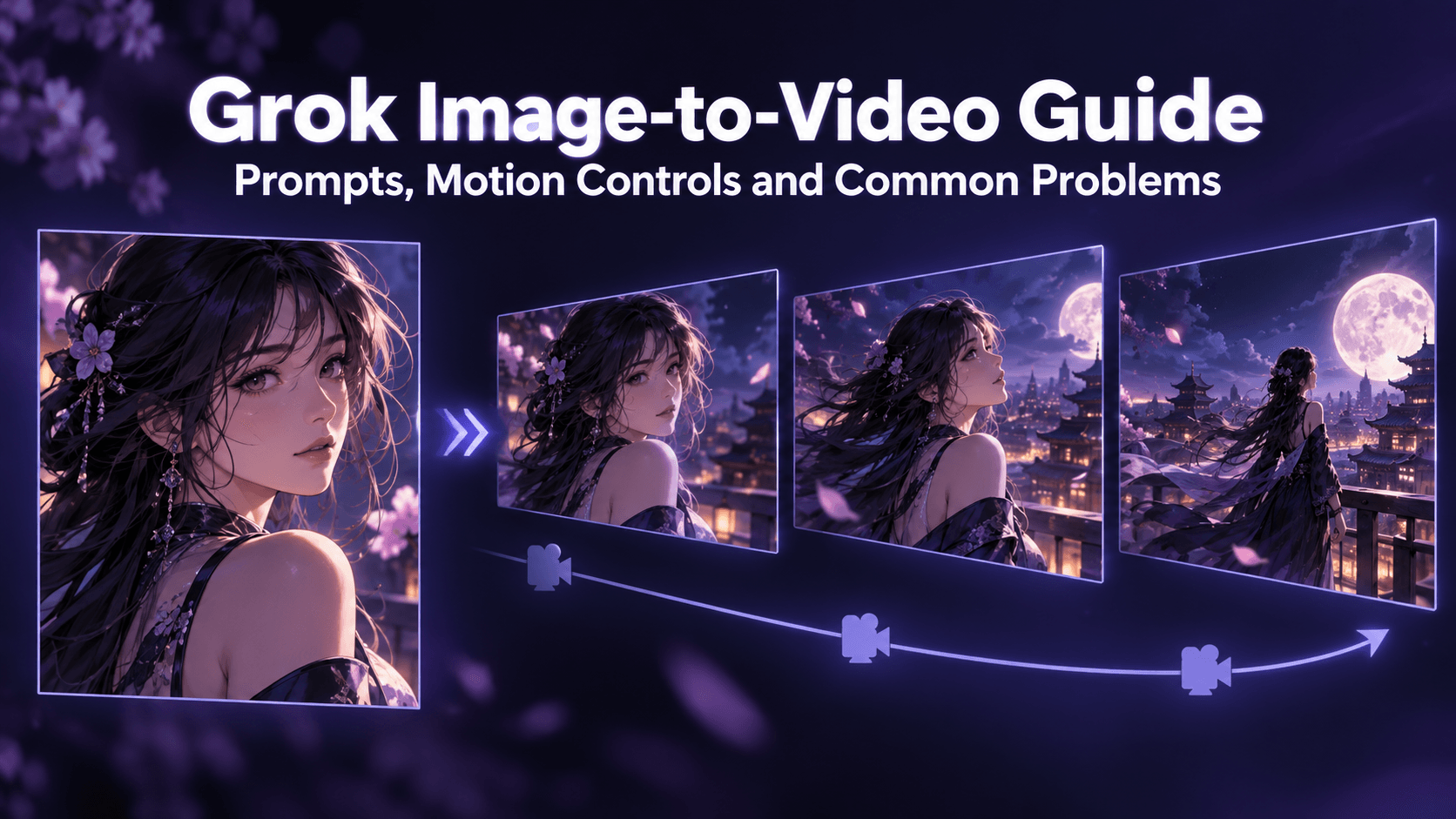
Grok Imagine can create video from a written prompt or a still image. The important decision is not which button to press. It is whether you want the model to invent the opening frame or animate a frame you already control.
Use text-to-video when composition is still flexible. Use image-to-video when the character, product, costume, location, or opening shot must begin from an approved design. For most character-focused work, the second path is easier to direct.
This guide separates the consumer Grok experience from the xAI API, explains a reliable workflow for both generation modes, and shows how to diagnose weak motion instead of repeatedly changing the entire prompt.
Accuracy note: Features, app limits, plans, and interfaces can change. The product and API details below were checked against official xAI documentation on September 18, 2026.
What Grok Imagine Video Currently Supports
xAI describes Grok Imagine Video 1.5 as supporting text-to-video, image-to-video, reference-to-video, first-and-last-frame control, editing, extension, generated audio, and output up to 1080p for supported modes. The consumer experience is available through Grok on the web and mobile apps, while developers can use the asynchronous Imagine API.
These are related products, not identical billing surfaces. A Grok subscription uses consumer-plan allowances. The API requires an API account and charges for media generation separately. Always confirm the current controls in the interface you are using.
Choose Text-to-Video or Image-to-Video
Text-to-video is best for exploration
The prompt defines both the initial scene and the motion. Use it for establishing shots, atmospheric experiments, visual concepts, or ideas where exact identity is not yet locked.
Example:
Wide cinematic shot of an abandoned elevated train station at blue hour. Rainwater
reflects violet signs on the platform. A lone courier in a yellow coat walks toward
camera as a train passes behind the glass wall. Slow forward dolly, realistic weight,
subtle coat movement, restrained ambient sound, no cuts.
Text-to-video asks one prompt to solve production design, casting, composition, and motion. That freedom can be useful, but it also gives you more variables to correct.
Image-to-video is best for controlled openings
The uploaded image establishes the first frame. The prompt should explain what changes after that moment rather than redescribe every pixel.
Example:
The courier takes two cautious steps toward camera and glances toward the passing train.
Her coat hem responds gently to the train's air pressure. The camera makes a slow,
stable push-in. Preserve her face, hairstyle, yellow coat, and the station layout.
No scene cut and no new characters.
This division of labor is especially useful for OCs, anime characters, product shots, and storyboards. Create or approve the still image first, then animate one clear beat.
A Reliable Step-by-Step Workflow
1. Define the shot’s narrative job
Write one sentence that explains why the shot exists:
The courier realizes she is being followed but chooses not to run.
That sentence helps you choose expression, timing, camera distance, and movement. Without it, a prompt often becomes a list of decorative effects.
2. Pick one primary action
Short generated clips handle one readable change better than a chain of unrelated events. Good primary actions include:
- turning toward a sound;
- stepping through a doorway;
- raising an object;
- shifting from suspicion to recognition;
- walking as the camera tracks alongside;
- wind or light revealing something already in frame.
If your prompt contains “then” three times, split it into separate shots.
3. Separate subject motion from camera motion
Write them as different instructions:
Subject: she closes the notebook, looks over her shoulder, and holds still.
Camera: slow lateral slide from left to right at chest height.
Environment: curtain and loose paper respond to a light breeze.
This makes revision easier. If the result feels chaotic, remove camera motion first and test the performance on a locked frame.
4. Protect what must remain stable
For image-to-video, identify only the crucial invariants:
Preserve facial identity, short silver hair, navy coat, orange shoulder patch,
and the shape of the handheld radio.
Do not repeat a 200-word image prompt unless the interface specifically requires it. Repetition can compete with the actual motion instruction.
5. Choose duration, aspect ratio, and resolution for the destination
Use the destination rather than habit:
- 9:16 for vertical short-form video;
- 16:9 for landscape scenes and YouTube;
- 1:1 when the final placement is square;
- lower-cost drafts before higher-resolution finals;
- short clips for one action beat.
The xAI API exposes duration, aspect ratio, and resolution controls. Availability in consumer apps can differ, so check the active interface rather than assuming every API parameter appears in the app.
6. Generate a small test
Evaluate four questions:
- Is the subject still recognizable?
- Is the main action readable without explanation?
- Does the camera behave as requested?
- Does the final frame provide a usable edit point?
Do not judge only by the most spectacular frame. A clip is useful when its movement can be edited into a sequence.
7. Change one variable per retry
If the face drifts, reduce head rotation or shorten the action. If the camera is wrong, lock it before changing the subject. If motion is weak, replace vague verbs such as “comes alive” with measurable actions.
A Practical Grok Video Prompt Formula
Use this order:
[shot size and scene]
[subject identity and starting state]
[one primary action]
[camera behavior]
[environmental response]
[timing and mood]
[continuity constraints]
[audio intent, if needed]
Example:
Medium-wide shot inside a quiet observatory at night. A young astronomer with a dark
braid and red work jacket stands beside a brass telescope, already looking through
the eyepiece. She slowly pulls back, notices an unexpected light outside frame, and
turns only her eyes toward it. Locked camera with a very subtle push-in during the
last two seconds. Star charts move slightly in the ventilation. Preserve her face,
jacket, telescope, and room geometry. Tense quiet ambience, no dialogue, no cut.
Common Failures and Focused Fixes
The character’s face changes
Reduce extreme rotation, fast movement, occlusion, or dramatic lighting changes. Use a clearer source image with a readable face. Ask for a smaller motion beat and preserve a short list of identity anchors.
The result zooms when you requested subject motion
Explicitly state “locked camera” and remove cinematic adjectives that imply camera movement. Describe what the body does in concrete verbs.
Nothing meaningful happens
“Subtle movement” may be too vague. Specify blinking once, shifting weight, lifting a hand to a marked height, taking two steps, or turning toward a named object.
Too many new objects appear
Use image-to-video and say that the existing scene composition remains unchanged. Remove prompts that imply a transformation of the whole environment.
Motion becomes distorted
Simplify contact-heavy actions. Hands manipulating small objects, crossed limbs, rapid spins, or multiple interacting people are difficult. Stage the action across several shots.
The clip looks impressive but cannot be edited
Ask for one continuous shot with no cut and a stable final pose. Plan entrance and exit direction across neighboring shots before generating them.
Using Grok Video in a Larger Creative Workflow
Grok can be effective for individual text-to-video or image-to-video experiments. A complete anime or narrative project also needs approved characters, repeatable references, shot organization, alternate takes, sound decisions, and continuity review.
One practical workflow is:
- design an original character and canonical reference;
- create a storyboard or approved starting frame;
- test motion in Grok or another suitable video model;
- compare takes against the same identity and shot goal;
- assemble the selected clips with sound and pacing.
Elser AI is useful when you want character-oriented image generation, OC creation, comic panels, and image animation in one creative environment. Use the tool that gives you the right control for each stage rather than assuming one model must perform the entire production.
Safety, Rights, and Responsible Inputs
Use images you own or have permission to animate. Do not create deceptive impersonations or non-consensual intimate media. If a source image includes another person, brand, artwork, or protected character, confirm that your intended use is lawful and allowed by the relevant platform terms.
Generated output also requires review. Look for altered logos, accidental text, identity drift, unsafe actions, or details that could misrepresent a real event.
FAQ
Can Grok create video from text?
Yes. Current official xAI documentation describes text-to-video generation. Grok Imagine Video 1.5 creates an initial frame from the prompt and animates it within a single request.
Can Grok animate an existing image?
Yes. Image-to-video uses the supplied image as the starting frame. A motion-focused prompt usually works better than repeating the entire image description.
Does Grok video include audio?
The current API documentation describes generated audio and preset voice options for supported modes. Controls and access can differ between the API and consumer apps.
What resolution does Grok video support?
xAI currently documents 480p, 720p, and up to 1080p for supported Grok Imagine Video 1.5 modes. Reference-to-video and editing modes can have different caps.
How long does generation take?
The API is asynchronous and xAI says generation can take several minutes depending on duration, resolution, complexity, and mode. Consumer-app wait times also depend on demand and plan limits.
Is Grok the best option for consistent anime characters?
No single model is best for every shot. Character consistency depends on source references, motion complexity, prompting, model behavior, and review. Test representative shots before committing an entire sequence.
Conclusion
The most reliable way to use Grok AI video is to make one decision at a time. Choose text-to-video for visual exploration and image-to-video for a controlled opening frame. Define one narrative beat, separate subject and camera motion, protect a few essential details, and revise only the variable that failed. That discipline matters more than adding more adjectives to the prompt.