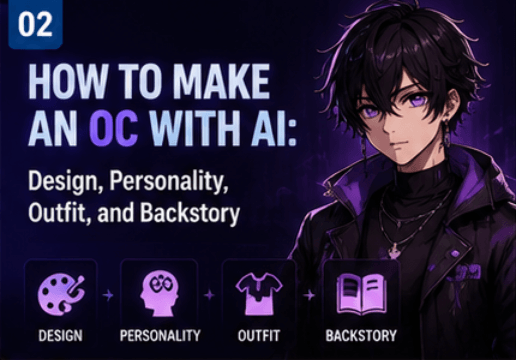
OC Maker Prompt Guide: How to Create More Original AI Characters
Most generic OC results begin with generic instructions.
“Beautiful anime girl, unique outfit, cool powers” asks the model to choose its most familiar face, fashion, and visual effects. Adding more adjectives often makes the image busier without making the character more specific.
A useful OC prompt does not attempt to write an entire biography. It translates a small number of connected character decisions into visible evidence: role, silhouette, identity, clothing function, prop, posture, palette, and production purpose.
Write the character sentence first
Use:
A clearly adult [role] who wants [goal] but [contradiction or limit].
Example:
A clearly adult lighthouse keeper who wants to train a replacement but is afraid of open water.
This sentence already suggests weather gear, tools, guarded posture, and story conflict.
Weak:
Mysterious powerful anime man.
Better:
Adult municipal astronomer who repairs streetlights that have begun displaying the wrong constellations.
Role and problem generate original details more reliably than “unique.”
Separate visible and invisible information
An image can show:
- apparent adult age;
- body and face structure;
- outfit;
- posture;
- expression;
- prop;
- environment;
- action;
- color and light.
It cannot directly show:
- childhood history;
- secret motivation;
- exact name pronunciation;
- moral philosophy;
- future character arc.
Do not overload the image prompt with invisible lore. Convert one invisible trait into behavior:
Distrusts praise → looks at repaired streetlight rather than cheering crowd.
Fears deep water → keeps back to lighthouse wall and eyes on horizon.
Write the biography in a separate character document.
Use the eight-block prompt
1. Adult status and role
Clearly adult, early forties, lighthouse keeper and mechanical lens technician.
Age clarity matters for design and safety. Role guides practical details.
2. Structural identity
Long narrow face, low straight eyebrows, deep-set dark eyes, close-cut black hair with one white streak at right temple, tall slightly stooped build.
Describe relationships and shapes, not beauty.
3. Silhouette
Short boxy work coat, narrow legs, square lantern carried low, large key ring at hip.
Silhouette protects identity in wide shots.
4. Outfit logic
Waxed yellow coat over slate sweater, high-waisted dark trousers, right knee brace, weathered work boots.
Ask whether the clothing supports the role and climate.
5. Signature prop
Square storm lantern with red inner lens; labeled brass keys on left hip.
Limit props. One strong object is easier to maintain than a mobile antique shop.
6. Pose and expression
Neutral three-quarter stance, weight favoring left leg, one hand on lantern handle, observant guarded expression.
Neutral production poses reveal design. Save action for later.
7. Palette and rendering
Slate-blue, waxed yellow, charcoal, brass, and one red accent; clean medium-weight anime linework, restrained cel shading.
Avoid conflicting style lists.
8. Production constraints
Plain warm-gray background, full body and feet visible, no text, no logo, no extra tools, preserve right-temple streak and knee-brace side.
Constraints explain the asset’s job.
The complete base prompt
Original character design, clearly adult lighthouse keeper and mechanical lens technician in early forties; long narrow face, low straight brows, deep-set dark eyes, close-cut black hair with one white streak at right temple, tall slightly stooped build; short boxy waxed-yellow work coat over heavy slate-blue sweater, dark high-waisted trousers, leather brace on right knee, weathered boots; square storm lantern with red inner lens carried low, labeled brass key ring on left hip; neutral three-quarter stance with weight on left leg, guarded observant expression; limited slate-yellow-charcoal-brass palette with red accent, clean medium-weight anime linework and restrained cel shading; plain warm-gray background, full body and feet visible, no text, no logo, no extra tools.
Generate four options with the same prompt. Choose the design that is easiest to reproduce, not the one with the most decoration.
Add originality through causal details
Ask “because” after every major item.
Why yellow coat? Because it remains visible in fog.
Why knee brace? Because years of spiral stairs changed the gait.
Why square lantern? Because it locks into the lens machinery.
Why red inner light? Because memory projection appears red.
Why labeled keys? Because the keeper fears forgetting routines.
If a detail has no answer, remove or replace it.
Originality often comes from an unusual connection between ordinary things, not from inventing an unprecedented hairstyle.
Create identity anchors
Choose three to five:
- white streak at right temple;
- waxed yellow short coat;
- right knee brace;
- square lantern;
- left-hip brass keys.
Repeat the wording exactly across prompts and store approved references in Elser AI or your chosen platform.
Separate “must keep” from “may vary.” Mud, coat closure, temporary gloves, and expression can change. Face, streak side, brace side, lantern shape, and key placement remain.
Prompt new scenes modularly
Keep the identity block and add a scene block:
Inside the lighthouse lens room during a storm, keeper braces square lantern into an empty machinery slot; medium-wide low camera, both hands visible, rotating glass lens behind; cool storm flashes through windows and red lantern light on face; preserve adult face, right-temple streak, yellow coat, right knee brace, square lantern, and left-hip keys.
Do not rewrite the entire character with new synonyms. Modularity makes drift easier to diagnose.
Use negative instructions for production needs
Useful:
- no text;
- no logo;
- full feet visible;
- no duplicate keys;
- no extra characters;
- do not exchange left and right details.
Less useful:
no bad anatomy, no ugly face, no weird, no low quality, no mistakes.
State what correct anatomy and composition should show. A negative list cannot replace direction.
Fix common prompt failures
Every result has the same generic face
Remove beauty words. Add structural face relationships and apparent age. Use an approved portrait reference.
Outfit becomes fantasy clutter
State profession, climate, and item count. Ask for practical construction and no extra accessories.
Power effect overwhelms character
Generate neutral design first. Add effect in a separate scene and restrict it to one color, shape, and source.
Character changes between scenes
Lock vocabulary and references. Reduce simultaneous changes. Approve new outfit and camera angles separately.
Prompt is too long
Delete invisible biography, redundant adjectives, and repeated style terms. Keep the eight visible blocks.
Build controlled variations
Change one axis per batch.
Batch 1: three silhouettes, same role and palette.
Batch 2: three coat constructions, selected silhouette.
Batch 3: three lantern designs, selected coat.
Batch 4: expression and posture.
Batch 5: final palette refinements.
This produces meaningful comparison. Asking for “ten very different versions” changes everything and teaches little.
Check for accidental derivation
Search the name, silhouette, palette, occupation, and signature prop. Compare with popular characters in the genre. Revise overlaps.
Do not use a living artist’s exact style as the identity of your OC. Describe broad craft properties. Do not attach official logos or franchise terminology unless the work is clearly labeled unofficial fan art.
For commercial work, use original worlds and confirm platform terms and source rights.
FAQ
Keep a prompt change log
Save each approved prompt beside its output and note exactly what changed: “shortened coat,” “moved keys to left hip,” or “reduced red accent.” This turns trial and error into design evidence. If identity drifts later, return to the last stable version instead of guessing which adjective caused the problem.
For collaboration, mark prompt blocks as locked or editable. A teammate can then change a scene without accidentally rewriting the face, silhouette, signature prop, or palette. Record the seed and reference versions when the chosen tool exposes them.
How long should an OC prompt be?
Usually 80–160 focused words for a base design. Clarity matters more than length.
Should I include personality in the prompt?
Include personality only when it changes posture, expression, clothing, or action. Keep deeper psychology in the character bible.
How many identity anchors are ideal?
Three to five strong anchors. More can make every scene brittle and difficult to maintain.
Can I reuse one prompt forever?
Keep the identity block stable but create approved view, outfit, and scene references. A prompt alone cannot define every angle.
Create Your Character Without Starting From Scratch
You now know how AI can help transform an idea into a complete character — but the real creative process starts when you begin experimenting.
With Elser AI, you can create original anime characters, fantasy heroes, game-style avatars, and story-ready designs using 50+ AI-powered OC Maker templates.
Choose a style, customize your character’s appearance, personality, outfit, and background story — or create a completely unique OC from your own imagination.
No drawing skills required. No complicated design tools. Just bring your idea, and let AI help you build it.
Start creating your first OC with Elser AI today.