How to Keep the Same Art Style Across AI Videos
One of the easiest ways to spot an amateur AI video is style drift. The first scene looks like clean anime. The second looks semi-realistic. The third becomes glossy 3D. The fourth has a different color palette, different lighting, and a different mood. Each clip may be attractive by itself, but together they feel like they came from different projects.
Keeping the same art style across AI videos is not just about aesthetics. It is about trust. When the style remains stable, viewers feel that the video belongs to one world. When the style keeps changing, the story feels unstable, even if the character and subject remain similar.
This matters for anime shorts, brand videos, product ads, educational animations, game trailers, music videos, comic-to-video workflows, and YouTube series. If you want to build a recognizable visual identity, style consistency is as important as character consistency.
The challenge is that AI models are highly sensitive to style language. Small prompt changes can shift the entire look. Words like “cinematic,” “anime,” “illustration,” “3D,” “realistic,” “cartoon,” “film still,” and “concept art” do not simply decorate the prompt. They actively steer the image. If you combine them carelessly, the model may reinterpret the style every time.
Style Consistency Starts with a Visual Bible
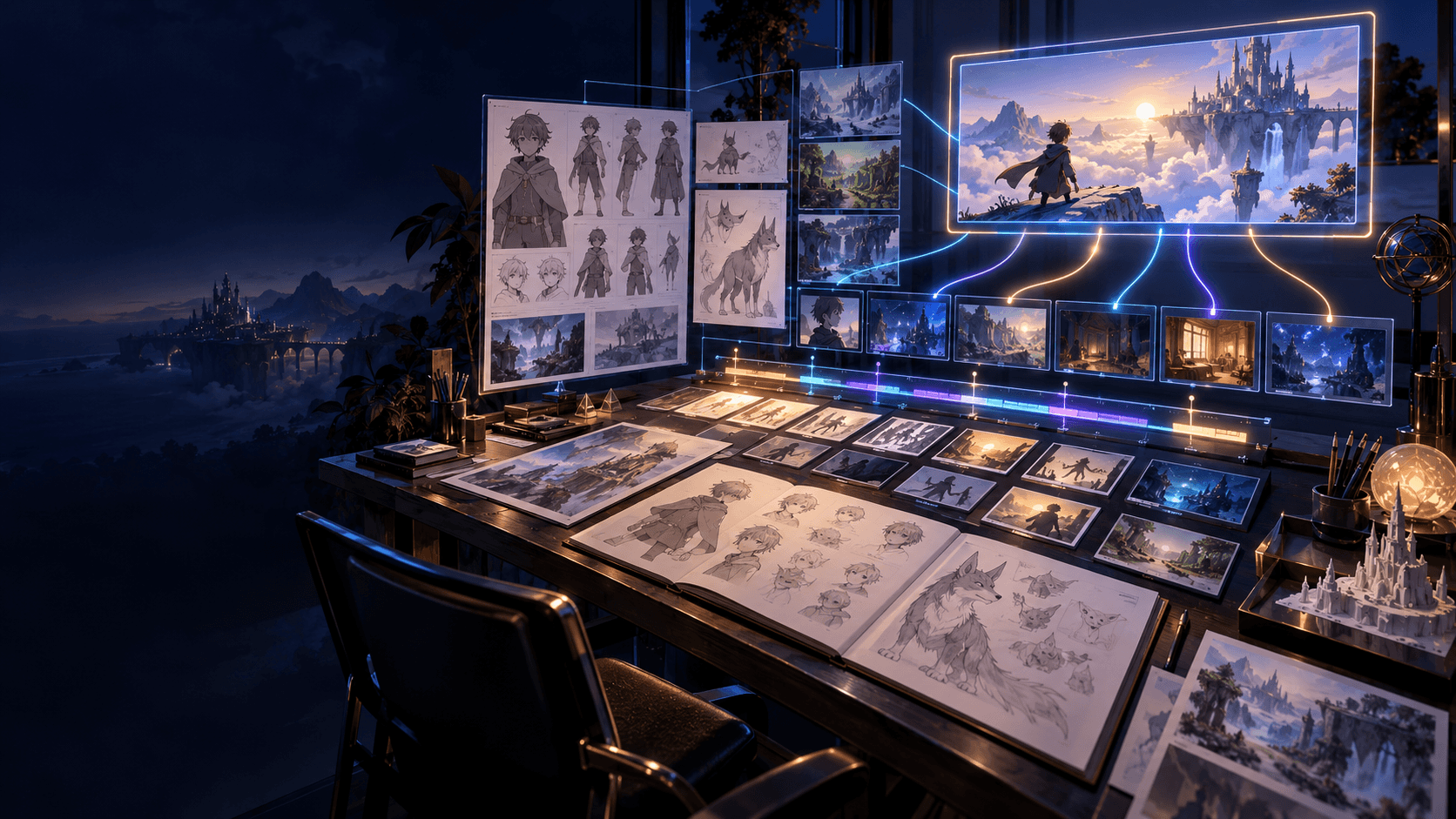
A professional production rarely invents style scene by scene. It uses a visual bible. This is a set of rules that defines how the world should look. In AI video, your visual bible does not need to be complicated, but it should be explicit.
It should define the art style, color palette, lighting, character rendering, background detail level, camera language, texture, and mood. For example, an anime short might define: clean 2D anime style, soft linework, warm pastel colors, gentle lighting, minimal background texture, expressive eyes, and slow cinematic camera movement. A tech product video might define: glossy 3D realism, dark gradient background, cyan highlights, clean reflections, shallow depth of field, and premium commercial lighting.
Once this is defined, reuse it across every prompt. Do not rewrite the style casually. Style consistency comes from repetition.
A weak style description:
“Make it cinematic and cool.”
A stronger style definition:
“Clean modern anime style, soft line art, warm pastel color palette, subtle cel-shading, gentle natural lighting, detailed but not realistic backgrounds, emotional cinematic composition.”
This gives the model a stable style target.
Use Style References Whenever Possible
Text alone can describe style, but images define style more strongly. If you have a key visual, concept art, brand image, character sheet, comic panel, or previous successful frame, use it as a style reference. Modern AI video workflows increasingly support reference-based generation, and Runway Gen-4 specifically emphasizes using visual references to create consistent styles, subjects, and locations.
A style reference helps because the model can see the actual line quality, color relationships, lighting mood, texture, and composition instead of guessing from words. This is especially useful when the style is specific, such as soft anime, webtoon, watercolor, 3D cartoon, cinematic realism, pixel-inspired, or manga panel animation.
In Elser AI, this becomes a practical workflow. You can register, upload or create your key visual, and use it as the anchor for multiple AI video scenes. Instead of asking the model to remember “your style” through text alone, you give it a visual base. This is important if you are creating a series, not just a one-off clip.
Avoid Mixing Conflicting Style Terms
Many creators accidentally create style drift by overloading prompts with too many aesthetic keywords. They write something like:
“Anime, cinematic, realistic, Pixar-style, oil painting, 3D, ultra-detailed, manga, film still, fantasy concept art.”
This does not make the output better. It creates style conflict. The model may mix features unpredictably, producing a scene that is neither clean anime nor cinematic realism nor 3D animation.
Choose one primary style and one or two supporting qualities. For example:
“Clean anime style with cinematic lighting.”
“Stylized 3D cartoon with soft product lighting.”
“Realistic commercial video with minimal tech aesthetic.”
“Webtoon-inspired animation with pastel colors.”
This keeps the style direction clear. If you want cinematic anime, say “anime style with cinematic lighting,” not “anime realistic film still 3D fantasy.”
The distinction matters. “Cinematic” should describe camera and lighting, not necessarily facial realism. “Anime” should describe character design and rendering. “Soft pastel” should describe color. The clearer you are about which style layer each word controls, the more stable the output becomes.
Keep Color and Lighting Consistent
Style is not only linework or rendering. Color and lighting define how a video feels. A scene with warm golden light belongs to a different emotional world than one with cold blue neon. If your color palette changes randomly, the art style feels inconsistent even if character design remains stable.
Create a color rule for the whole video. For example:
“Warm pastel palette with soft peach, cream, light blue, and gentle green.”
“Dark cyberpunk palette with deep navy, cyan highlights, magenta reflections, and black shadows.”
“Clean SaaS promo palette with white, light gray, blue accents, and soft gradients.”
Then repeat that palette in your prompts. Do the same with lighting. If your video uses soft natural daylight, keep that lighting unless the story requires a change. If it uses high-contrast cinematic shadows, maintain that mood across scenes.
When lighting changes are needed, make them intentional. A character leaving a room and stepping outside can justify a lighting shift. A magical transformation can justify color change. A random cut should not.
Maintain the Same Camera Language
Camera movement affects style more than many creators realize. A static symmetrical shot feels different from a handheld close-up. A slow anime push-in feels different from a fast 3D camera orbit. If each AI video clip uses a different camera language, the style feels unstable.
Define a camera style. For example, your anime short might use slow push-ins, gentle pans, and emotional close-ups. Your product ads might use slow rotations, clean macro shots, and stable studio movement. Your educational videos might use simple camera moves and readable diagrams.
Then stay consistent. The camera should support the visual identity of the series.
A useful prompt line:
“Use the same visual style and camera language as the previous scene: slow cinematic push-in, stable framing, soft lighting, and clean anime composition.”
This tells the model that style includes movement, not only appearance.
Create Reusable Style Prompt Blocks
A reusable style block is one of the easiest ways to reduce style drift. Write one paragraph that defines your style and paste it into every scene prompt.
Example for anime:
“Visual style: clean 2D anime look, soft line art, expressive eyes, gentle cel-shading, warm pastel palette, detailed but not realistic backgrounds, cinematic composition, subtle camera movement, no photorealism, no 3D rendering, no style drift.”
Example for product ads:
“Visual style: premium commercial product video, dark gradient background, realistic reflections, soft studio lighting, clean composition, high-end ecommerce aesthetic, no cartoon style, no random props, no visual clutter.”
Example for educational animation:
“Visual style: clean educational animation, simple shapes, readable labels, bright friendly colors, smooth slow motion, minimal decoration, clear visual hierarchy, no complex cinematic effects.”
These blocks help preserve style across multiple outputs. They also make production faster because you are not reinventing the style every time.
Use Elser AI as a Style Workflow Layer
If you are producing one clip, style drift may not matter much. But if you are creating a series, campaign, course, anime short, product ad set, or social content system, you need style control over time.
Elser AI is useful because it helps creators work from visual references and repeatable generation patterns. You can build a style direction once, create scenes from it, test motion variations, and maintain a consistent look across your content. This is especially valuable for anime creators, brand marketers, YouTube Shorts creators, educators, and ecommerce teams.
If you are tired of AI videos looking like they came from five different tools, register on Elser AI and create a style anchor first. Upload a key visual, generate one successful clip, then reuse that visual direction for the next scenes. Your goal is not just to generate more videos. It is to build a recognizable visual identity.
Final Thoughts
Keeping the same art style across AI videos requires more than adding “same style” to a prompt. You need a visual bible, style references, consistent color palettes, stable lighting, compatible camera language, and reusable style prompt blocks.
The best AI creators treat style like a production asset. They define it, protect it, and reuse it.
If you want to create AI videos that feel like one coherent project instead of random outputs, start with Elser AI. Register, create or upload your style reference, and build a repeatable video workflow around it. A consistent art style makes your content more professional, more memorable, and much easier to scale.