Best AI Video Generators with Lip Sync for Anime Music Videos in 2026
A singing anime character exposes every weak link in an AI video workflow. The illustration must stay recognizable, the mouth must follow the vocal, the face must carry emotion, the body must move naturally, and the camera still has to serve the song. A general video model may produce spectacular motion but fuzzy syllables. A specialized avatar model may deliver excellent lip sync while keeping the character in a mostly fixed composition.
That is why the best AI lip-sync generator depends on the shot. As of July 22, 2026, the most relevant options include HeyGen Avatar IV and Avatar V, Hedra Character 3, Kling 3.0, Google Veo 3.1, and anime-focused workflow platforms such as Elser AI. This guide separates officially documented features from workflow recommendations; it does not present vendor claims as independent benchmark results.
Quick recommendations
- Best for a stylized or anime portrait singing to an uploaded track: HeyGen Avatar IV.
- Best for a simple talking or singing character from one image: Hedra Character 3.
- Best for cinematic full-scene performance with native audio: Kling 3.0 or Veo 3.1.
- Best for a real-person digital twin: HeyGen Avatar V, subject to consent and verification requirements.
- Best for an anime-first pipeline with character, music, lip sync, and video tools: Elser AI.
The strongest music videos often combine two categories: a specialized tool for close-up singing and a general video model for instrumental cutaways, dance shots, environments, and transitions.
What good AI lip sync looks like
Lip sync is more than opening a mouth on the beat. Review five things:
Phoneme accuracy
Consonants such as M, B, P, F, and V create distinctive mouth shapes. If every syllable becomes the same open-close loop, the result feels dubbed even when timing is roughly correct.
Emotional alignment
The face should understand the performance. A whispered line needs different eyes, brows, and jaw tension from a shouted chorus. The best systems use the audio’s rhythm and emotion, not only its transcript.
Identity preservation
The character should still look like the reference when the mouth opens, the head turns, or the expression intensifies. Anime faces are especially sensitive because small changes to eye size, chin shape, or hairline can create a different character.
Head and body motion
A perfectly synchronized mouth on a frozen body still looks synthetic. Subtle breathing, blinks, head tilts, shoulder rhythm, and hand gestures sell the performance.
Shot-to-shot continuity
The close-up, medium shot, and side angle must belong to the same performer. This is where a character sheet and a consistent color pipeline matter.
1. HeyGen Avatar IV: best for stylized characters and singing portraits
HeyGen’s current help documentation positions Avatar IV as especially suitable for photo avatars, stylized characters, 2D art, 3D characters, and non-human faces. It accepts a script or uploaded audio and generates synchronized facial movement and expression. HeyGen explicitly suggests uploading a song when you want an avatar to sing.
Avatar IV is a strong choice for anime close-ups. Start with a clean face or upper-body illustration. Avoid hair covering the mouth, extreme profiles, and tiny faces.
HeyGen also offers Avatar V, its newer digital-twin model for real human avatars. Official guidance says Avatar V is best for real people, while Avatar IV remains better suited to virtual, 2D, 3D, and non-human characters. Do not automatically choose the higher number; choose the model designed for the subject.
HeyGen currently advertises limited free access in its consumer product, but premium features and quotas vary by plan and region. Its API no longer includes free credits as of 2026, so distinguish web-app testing from programmatic production.
2. Hedra Character 3: best straightforward image-to-video lip sync
Hedra Character 3 is a specialized image-to-video model that processes image, text, and audio to animate a talking or singing character. Hedra’s current materials emphasize accurate lip sync, micro-expressions, blinks, eye shifts, and subtle head movement. It is well suited to a locked-camera host, singer, newsreader, or character monologue.
Prepare a clear portrait, clean audio, and a delivery description. Hedra recommends a front-facing or three-quarter view; profiles are harder.
Character 3 is not the tool for every wide dance sequence. Use it where its specialization matters: a chorus close-up, spoken intro, emotional bridge, or character reaction. Then cut to wider shots created elsewhere.
3. Kling 3.0: best for cinematic performance with multilingual native audio
Kuaishou’s Kling 3.0 announcement describes native audio generation across several languages and accents, alongside multimodal video and image models. That creates opportunities for scenes where a character sings, speaks, moves, and interacts with the environment in one generation.
Kling is a better candidate than a portrait avatar when the shot needs full-body choreography, moving cameras, multiple characters, or an animated environment. However, broader freedom can reduce mouth precision. For an important lyric, test short clips and keep the face large enough to evaluate.
Use Kling for visual performance, but replace weak close-ups with specialist lip sync when needed.
4. Google Veo 3.1: best for cinematic audio-visual scenes
Veo 3.1 is Google DeepMind’s leading video model and supports audio in relevant creation workflows. Google documents reference ingredients, improved creative control, and audio-visual generation. For an anime music video, that is useful for atmospheric openings, narrative interludes, instrumental sequences, and moments where sound effects are integrated with the scene.
Veo is not primarily marketed as a dedicated portrait lip-sync engine. Judge dialogue and singing shot by shot. When the mouth must be exact, generate or animate that close-up in a specialized tool and use Veo for the surrounding cinematic world.
Google’s availability spans products including Gemini, Flow, APIs, and enterprise services, but features and quotas are not identical across surfaces. Confirm the interface you actually have.
5. Elser AI: best anime-first creative workflow
Elser AI currently combines anime character creation, image generation, comics, storyboards, video, lip sync, voices, music, and sound effects. For an independent creator, that can be more valuable than selecting a single frontier model.
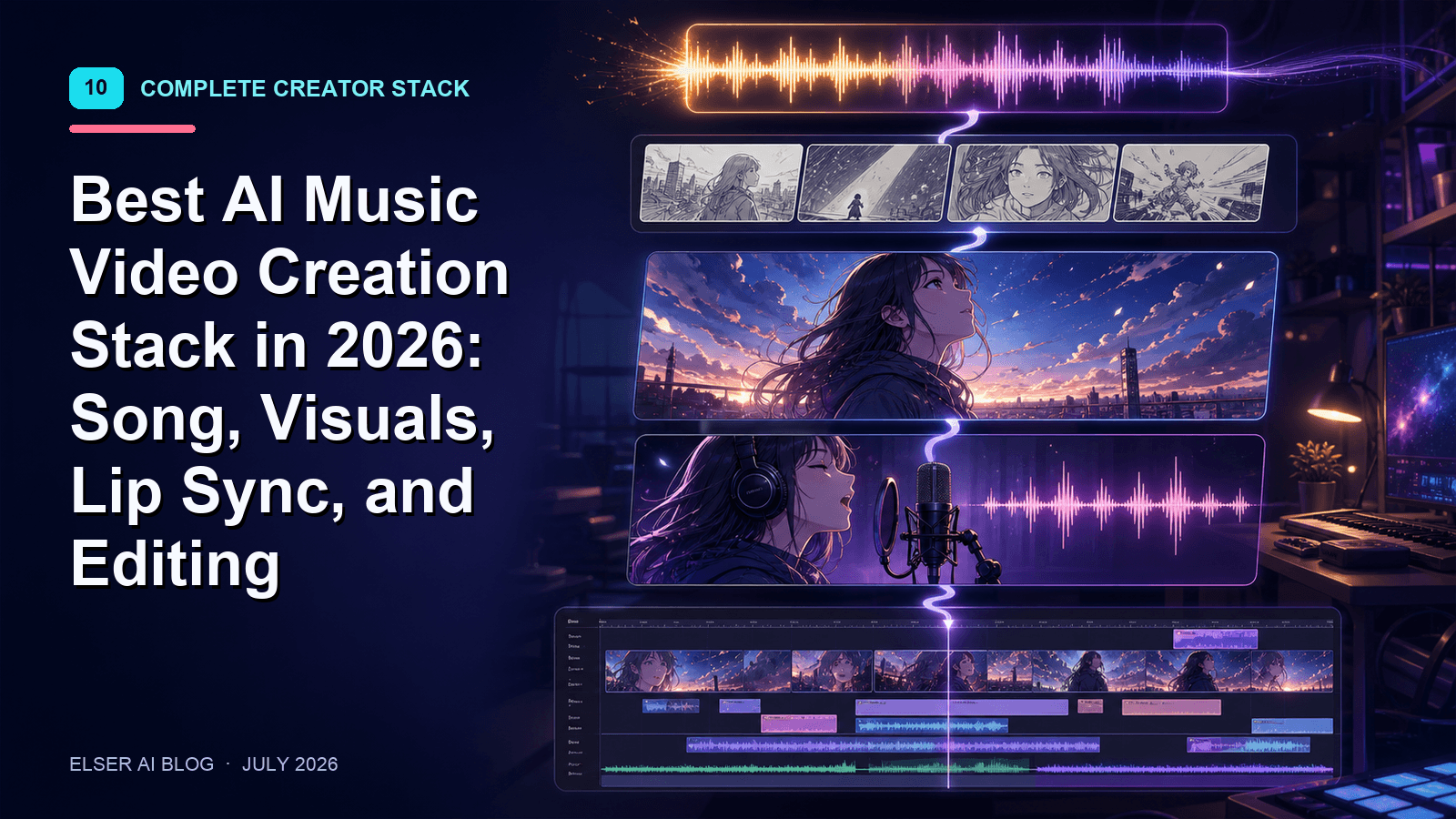
A practical workflow is to build the character and expression sheet, storyboard the song, generate establishing and action shots, create the lip-synced performance clips, and assemble sound elements without losing the anime-specific context. Elser should be evaluated on the complete workflow: how quickly you can move from a character idea to a coherent music-video sequence.
Avoid using any voice or likeness without permission. An original character and an original or properly licensed song provide the cleanest foundation.
A reliable anime lip-sync workflow
Step 1: finish the audio first
Use the final vocal edit, not a temporary recording. Remove room noise and heavy reverb before lip-sync generation; add creative reverb back in the mix later. Keep the sample rate and timing fixed once animation starts.
Split the song into manageable clips. Eight to fifteen seconds is a useful editing unit for many tools, but the best duration depends on the model. Include a small audio handle before and after each segment so cuts do not clip consonants.
Step 2: design performance shots by purpose
Create three categories:
Hero lip-sync shots
Close-up or medium close-up, simple background, clear mouth, emotionally important lyrics. Use Avatar IV or Hedra first.
Motion shots
Full-body dance, walking, camera orbit, interaction, dramatic environment. Test Kling or Veo.
Cutaways
Hands on instruments, city lights, memories, symbolic objects, crowd reactions, or abstract visuals. These hide edit points and reduce the amount of perfect lip sync required.
Step 3: prepare a lip-sync-friendly character image
Use a clear face at least several hundred pixels tall. Keep the mouth visible and closed or neutrally relaxed. Avoid a huge open-mouth smile in the source. Ensure the eyes, hairline, jaw, and signature accessories are crisp.
For anime art, preserve the exact line weight and shading style across reference images. If the source has painterly lips but other shots use cel shading, the performance will feel inconsistent even when the sync is accurate.
Step 4: generate short, reviewable takes
Create multiple takes of the same line with slightly different performance direction: “restrained and intimate,” “confident with a subtle smile,” or “urgent, almost breathless.” Do not change the character description between takes.
Review at normal speed, half speed, and with audio muted. Normal speed reveals believability; half speed reveals phoneme errors; muted playback reveals whether the facial performance works without the song carrying it.
Step 5: edit before regenerating
If one word fails, cut to a hand, instrument, or wide shot. If the final frames drift, end the clip earlier. If the verse is strong but the mouth slips during a sustained note, use a profile silhouette or environmental insert. Smart coverage is cheaper than demanding one flawless generation.
Common mistakes
Asking a general model to do every shot
Native audio is convenient, not automatically precise. Use specialized lip sync where the mouth is the focus and general models where motion and world-building matter.
Using compressed or noisy audio
Background instruments can mask consonants. When possible, drive the animation with a clean vocal stem and replace it with the mastered mix in the editor.
Making the singer too small
If the face occupies ten percent of the frame, you cannot judge sync and the model has fewer pixels to express it. Generate a dedicated close-up.
Ignoring consent and rights
Do not clone a real singer’s voice, face, or performance without authorization. Verify commercial rights for the song, voice, character art, and every generation platform used.
FAQ
What is the best AI lip-sync generator for anime characters?
HeyGen Avatar IV and Hedra Character 3 are strong specialized choices for stylized portrait animation. For cinematic full-body scenes with audio, Kling 3.0 and Veo 3.1 are better candidates, though mouth precision should be tested.
Can an AI avatar sing instead of speak?
Yes. HeyGen explicitly supports uploaded song audio for Avatar IV, and Hedra showcases singing characters. Clean vocal audio and a clear face reference improve the result.
Is HeyGen Avatar V better than Avatar IV for anime?
Not necessarily. HeyGen’s current guidance says Avatar V is intended for real human digital twins, while Avatar IV is better suited to virtual, stylized, 2D, 3D, and non-human characters.
How do I keep the same anime singer in every scene?
Use one approved character sheet, generate image-to-video rather than relying only on text, keep wardrobe and palette language fixed, and create short shots. Use cutaways to connect clips without showing the face continuously.
Can I make an AI music video for free?
Several tools provide limited free or trial access, but quotas, watermarks, model availability, and commercial terms vary. Free access is usually enough to test a chorus or proof of concept, not an unlimited polished video.
Conclusion
The best AI lip-sync tool is a casting decision. HeyGen Avatar IV and Hedra Character 3 are specialists for close-up anime performances. Kling 3.0 and Veo 3.1 offer more cinematic freedom when the whole scene needs to sing, move, and breathe. Elser AI can connect character, storyboard, video, lip sync, and sound inside an anime-oriented workflow.
Build around the edit: finish the audio, plan hero close-ups and cutaways, animate short takes, and use each tool where it is strongest. A convincing anime music video is rarely one uninterrupted generation. It is a sequence of deliberate shots that makes the performance feel whole.