Seedance 2.5 Character Consistency Guide: References, Prompts, and Scene Extensions
Character consistency is not one problem. A model can preserve a face but change the outfit, preserve the outfit but alter body proportions, or keep both while changing the character's apparent age. In motion, identity can also drift gradually rather than fail in a single obvious frame.
Seedance 2.5 is built for stronger reference-based generation and longer storytelling. ByteDance reports support for up to 30 image, 10 video, and 10 audio references per generation, alongside smoother transitions, multi-round extension, and timestamp-level editing. Those capabilities increase control, but the creator still has to define what “the same character” means.
This guide treats consistency as a production system: identity specification, reference selection, prompt discipline, shot design, review, and repair.
Define the Identity Before You Defend It
Write an identity specification with three tiers.
Tier 1: Non-Negotiable Anchors
These are the features that must survive every shot:
- face shape and apparent age;
- eye color and spacing;
- hair color, silhouette, and parting;
- body proportions;
- signature outfit silhouette;
- one or two distinctive accessories.
Keep the list short. Five strong anchors are easier to preserve than 25 equally emphasized details.
Tier 2: Controlled Variables
These may change when the story requires it:
- expression;
- pose;
- hair movement;
- jacket open or closed;
- dirt, rain, or battle damage;
- lighting color.
Tier 3: Scene-Dependent Details
These belong to the environment, not the character: reflected light, atmospheric particles, temporary props, and contact shadows.
If you need to design this foundation, Elser AI can help you build an original character and carry the same profile into storyboard and scene creation.
Build a Reference Pack That Resolves Ambiguity
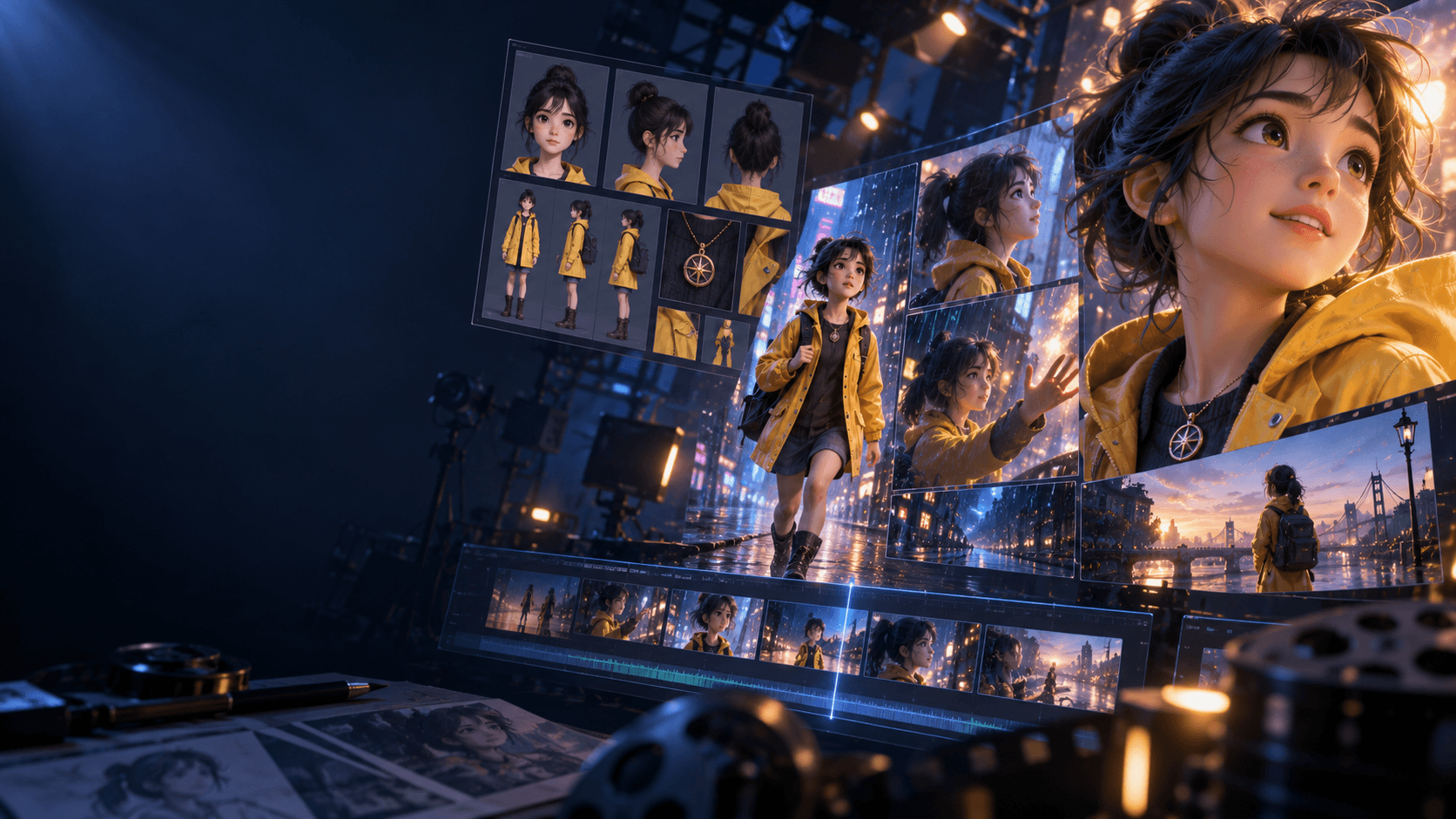
More reference images can help only when they agree. A practical pack contains:
- Neutral portrait: clear face, relaxed expression, even light.
- Full-body front view: readable proportions and outfit.
- Three-quarter view: face and silhouette under perspective.
- Side view: nose, chin, hairstyle depth, and costume profile.
- Back view: hairstyle and outfit construction.
- Expression sheet: separate, clearly labeled emotions.
- Accessory close-up: only if the prop is a major identity anchor.
Do not use a dramatic action illustration as the only face reference. Foreshortening, motion blur, colored light, and partial occlusion make it harder to infer neutral identity.
Avoid mixing generations created from different character descriptions. Small differences accumulate into an ambiguous average. If you update the character design, create a new canonical pack and archive the previous version.
Assign Every Reference a Role
Seedance 2.5's large reference capacity should be treated like a labeled production library. In the prompt, state what each asset controls:
@Image1 is the canonical face reference. @Image2 defines full-body proportions and the complete outfit. @Image3 defines hairstyle from the side and back. @Image4 defines the brass compass accessory only. @Video1 is a motion reference for the running cycle; do not copy its actor, clothes, or environment. @Image5 defines the moonlit station environment; do not transfer its character.
This distinction matters because a motion reference can otherwise compete with the identity reference. The official Seedance materials describe more flexible interpretation of motion and creative references, but explicit role assignment still reduces confusion.
Use One Character Lock Everywhere
Create a stable paragraph and paste it unchanged into every generation and extension:
Character lock — Mira: original 22-year-old anime courier; oval face; warm amber eyes; short silver hair with a straight left-side part and one narrow braid behind the right ear; slim athletic proportions; fitted navy flight coat with muted-gold seams; black gloves; small brass compass fixed at the throat. Preserve apparent age, facial geometry, eye color, hairstyle silhouette, body proportions, coat design, and compass in every shot.
Do not call the hair “silver” in one prompt, “white” in another, and “platinum lavender” in a third. To a human these may feel compatible; to a generative system they are separate instructions.
Use a second paragraph for controlled scene changes:
Allowed variation: natural wind in hair and coat; determined-to-relieved expression change; wet fabric from rain. No haircut, makeup change, jewelry change, color shift, or costume redesign.
Plan Camera Angles Around Identity Risk
Put the reference pack to work in a real sequence: register with Elser AI and test the character in a close-up, profile, and full-body scene before scaling production.
The most difficult cuts often combine several changes: wide to extreme close-up, front to profile, calm to fast action, daylight to colored night light. Instead of stacking every change at once, introduce them progressively.
A safer sequence is:
- neutral medium three-quarter shot;
- wider action shot with the same screen direction;
- close-up after the action settles;
- profile only after identity is established;
- extreme angle as a deliberate hero shot.
Use transitional occlusion carefully. A coat passing the lens can hide a cut, but it can also give the model permission to redesign what reappears. Restate the character lock immediately after a major occlusion or scene transition.
Separate Character, Outfit, and Style Consistency
Evaluate these dimensions independently.
Character Identity
Check face geometry, age, eye placement, hairline, and body proportions. Color alone is not identity.
Outfit Continuity
Check collar shape, sleeve length, seams, fasteners, footwear, and accessory position. “Black fantasy outfit” is too vague for multi-shot continuity.
Rendering Style
Check line weight, facial simplification, texture, shading, depth of field, and saturation. The same design rendered as soft shoujo art and detailed cinematic anime can appear like two different people.
Elser's character, storyboard, and editing tools can keep these decisions visible in one project. That is more reliable than trying to reconstruct the specification from memory each time you switch tools.
Prompt a Multi-Shot Scene Without Identity Drift
20-second cinematic anime sequence using @Image1–@Image5 as assigned references.
Character lock: [paste canonical lock unchanged]. Style lock: polished cinematic anime, precise facial linework, restrained violet-and-gold palette, realistic cloth motion, consistent lens language.
0–5s: medium three-quarter tracking shot as Mira walks right through the moonlit station, compass visible. 5–10s: wider side shot, same screen direction. She begins running as the train moves. 10–15s: close-up from the same side as she reaches for the rail; preserve face and glove anatomy. 15–20s: interior medium shot after she boards, hair settling, relieved expression. Coat and compass unchanged.
Continuity: same person, apparent age, facial geometry, hair silhouette, braid position, proportions, coat construction, gloves, and compass. The station and train retain the same architectural language. No duplicate character, outfit substitution, accessory movement, or style change.
The repeated detail may look redundant to a writer. It is useful to a generator because identity is a hard constraint, not background flavor.
Extend Without Resetting the Character
An extension prompt needs a state handoff:
- where the character is;
- what direction they face;
- what they hold;
- the current expression;
- what has changed since the original reference;
- the unchanged identity anchors.
Extend from the final frame. Mira is inside the train beside the closed door, facing right, breathing hard, with rain on her coat and her left hand holding the brass compass. Preserve the exact face, hair, braid, body proportions, coat, gloves, and compass from the preceding clip. The train begins moving; she looks through the window and sees the station lights recede. Do not reset her to a dry outfit or introduce a new accessory.
ByteDance says Seedance 2.5 supports multi-round extensions and is intended to maintain a coherent audiovisual language across longer work. Still, each extension creates another opportunity for drift. Compare the last clean frame of the previous segment with the first stable frame of the new one.
Diagnose Drift Before Regenerating
Use a failure matrix:
| Symptom | Likely cause | First correction | | Face changes only in close-ups | insufficient facial reference or style shift | strengthen neutral portrait and style lock | | Outfit changes after a cut | vague garment description | specify construction and transition state | | Character looks younger | changing facial proportions or rendering style | lock apparent age and facial geometry | | Hair grows during action | motion blur interpreted as shape change | add side/back reference and silhouette lock | | Accessory moves sides | mirrored framing ambiguity | state exact body-relative position | | Identity drifts slowly | repeated extension without canonical reset | reintroduce clean reference and state handoff |
Change one variable at a time. If you replace all references, rewrite the prompt, and change the camera simultaneously, you will not know which fix helped.
Use Timestamp-Level Repair
If continuity notes are becoming disconnected from the story, bring the character, storyboard, and scene workflow together in Elser AI and revise from the approved state.
When one interval fails, edit only that interval if your Seedance deployment exposes the feature:
Edit 8.5–11.0 seconds only. Preserve motion, background, camera, lighting, and audio. Restore Mira's canonical face and short silver hairstyle from @Image1 and @Image3. Keep her navy coat and brass compass exactly as in the frames before 8.5 seconds. Do not change pose, timing, or environment.
For an outfit error:
Correct the coat from 13–16 seconds. It must retain the fitted navy silhouette, muted-gold seams, high collar, and full sleeves defined by @Image2. Keep face, hair, hands, camera, motion, rain, and sound unchanged.
Targeted edits are not guaranteed to be perfectly local. Always inspect the boundaries around the edited interval.
Run a Consistency Review
Before approving a sequence, capture frames from every shot and place them in a grid. Review in this order:
- silhouette at thumbnail size;
- face at equal scale;
- outfit components;
- accessory side and placement;
- color under neutralized exposure;
- body proportions;
- style and line treatment.
A contact sheet reveals gradual drift that is hard to notice at playback speed. It also creates evidence for the next correction instead of relying on “the character feels different.”
When a shot fails, Elser AI lets you keep the larger animation workflow intact while refining characters, scenes, voice, and edit decisions around the problem area.
FAQ
Does Seedance 2.5 guarantee character consistency?
No generative video model should be treated as a guarantee. Seedance 2.5 introduces stronger reference and continuity capabilities, but results depend on inputs, prompt design, shot difficulty, and the product implementation.
Should I use all 30 available image references?
Usually not. Use enough references to remove ambiguity. Conflicting or redundant images may make the target identity less clear.
Is a character sheet better than one beauty portrait?
For multi-angle video, yes. A portrait gives facial detail but not complete proportions, outfit construction, or side and back views.
How do I keep an outfit stable after it becomes wet or damaged?
Describe the change as a state of the same garment: “the same navy coat, now wet at the shoulders,” rather than introducing a new clothing description.
Why does my character change during an extension?
The extension may over-weight the final stylized frame or lack a clear state handoff. Reattach the canonical references and restate both current state and permanent anchors.
Conclusion
Character consistency improves when identity stops being an adjective and becomes a specification. Build one canonical reference pack, assign each asset a role, reuse the same character lock, reduce unnecessary camera risk, and repair local failures locally. Seedance 2.5 provides more reference capacity and editing control than earlier clip-first workflows; disciplined preproduction is what turns that capacity into a character viewers can recognize from the first shot to the last.