Best OC Maker in 2026: Create an Original Character Without Drawing
An OC maker can give you a face, outfit, and color palette in seconds. It cannot decide why the character deserves a story.
That distinction is the best way to choose a tool in 2026. If you only need a profile picture, fast visual variety may be enough. If you want an original character who can appear in comics, storyboards, and videos, you need reusable references, consistent identity, editable design decisions, and somewhere to develop the character beyond a portrait.
This guide explains what “best OC maker” should mean for different creators and walks through a no-drawing character test.
Choose by destination
Different OC makers solve different jobs.
Avatar makers are fast and structured. You choose hair, eyes, clothing, and accessories from menus. Consistency is strong because assets are fixed, but originality is limited to available combinations.
Text-to-image character generators offer broad visual freedom. They can invent unusual silhouettes and settings, but repeated characters may drift.
Character-sheet tools focus on multiple views, expressions, and outfits. They are better for production than a single portrait.
Story platforms connect the OC with comics, storyboards, or animation. Elser AI fits this category: its public product links an OC maker and character generation with images, comics, manga, video, voice, and sound.
3D character creators are useful for games and animation when rigging, topology, and real-time use matter. They solve a different production problem from anime image generation.
Write your destination first: social avatar, reference sheet, roleplay character, webtoon cast, visual novel, game concept, or animated short.
The six-part OC quality test
Score a candidate tool on:
1. Identity control: Can you define and preserve facial and silhouette features?
2. Reference reuse: Can the character return in new scenes?
3. Design range: Can it create more than one fashionable default?
4. Editing: Can you repair one detail without restarting?
5. Story portability: Can the OC move into comics or video?
6. Rights clarity: Are upload and commercial terms available?
Add cost per accepted design. A cheap generation is not cheap when twenty attempts produce the same generic face.
Build a character before using the maker
Create a character engine:
Adult municipal gardener who secretly grows tiny weather systems in glass jars.
Add:
- Want: earn permission to restore the city’s abandoned greenhouse.
- Fear: losing control of a storm and hurting someone.
- Contradiction: patient with plants, impatient with people.
- Limitation: each jar works only while she remembers the exact weather it contains.
Now design can support story.
Visual brief:
Clearly adult woman, mid-thirties; short sturdy silhouette; broad oval face; tightly curled dark hair in a high puff; pale gray eyes; moss-green utility coat with transparent weatherproof pockets; yellow rubber gloves clipped to belt; one small cloud jar carried in a padded chest harness.
The transparent pockets and harness come from the job. The cloud jar is a story prop. The silhouette is readable.
Generate a neutral base
Start with:
Full-body original anime character design of a clearly adult municipal gardener, mid-thirties, short sturdy silhouette, broad oval face, high puff of tight dark curls, pale gray eyes, moss-green utility coat with transparent weatherproof pockets, yellow gloves clipped to belt, padded harness holding one glass jar with a tiny cloud; neutral three-quarter pose, plain light background, even studio light, practical clothing construction, clean linework, no text, no logos.
Choose for design logic:
- Can she move and work?
- Does the jar attach safely?
- Are pockets coherent across the coat?
- Is the face distinctive without accessories?
- Does the silhouette read at thumbnail size?
Save the approved design. Generate front, side, and back views separately if a combined sheet contradicts itself.
Test originality with subtraction
Remove the fashionable details mentally. Is there still a person?
The character should remain interesting without “beautiful,” “cool,” rare eye colors, decorative belts, or a famous franchise setting. Her weather memory, civic goal, social impatience, and glass-jar work create originality through relationships.
Run a search for the proposed name and inspect similar characters. Change accidental overlap in silhouette, profession, color pattern, or signature object.
Avoid using a living artist’s name as a shortcut. Describe line, material, light, shape, and palette.
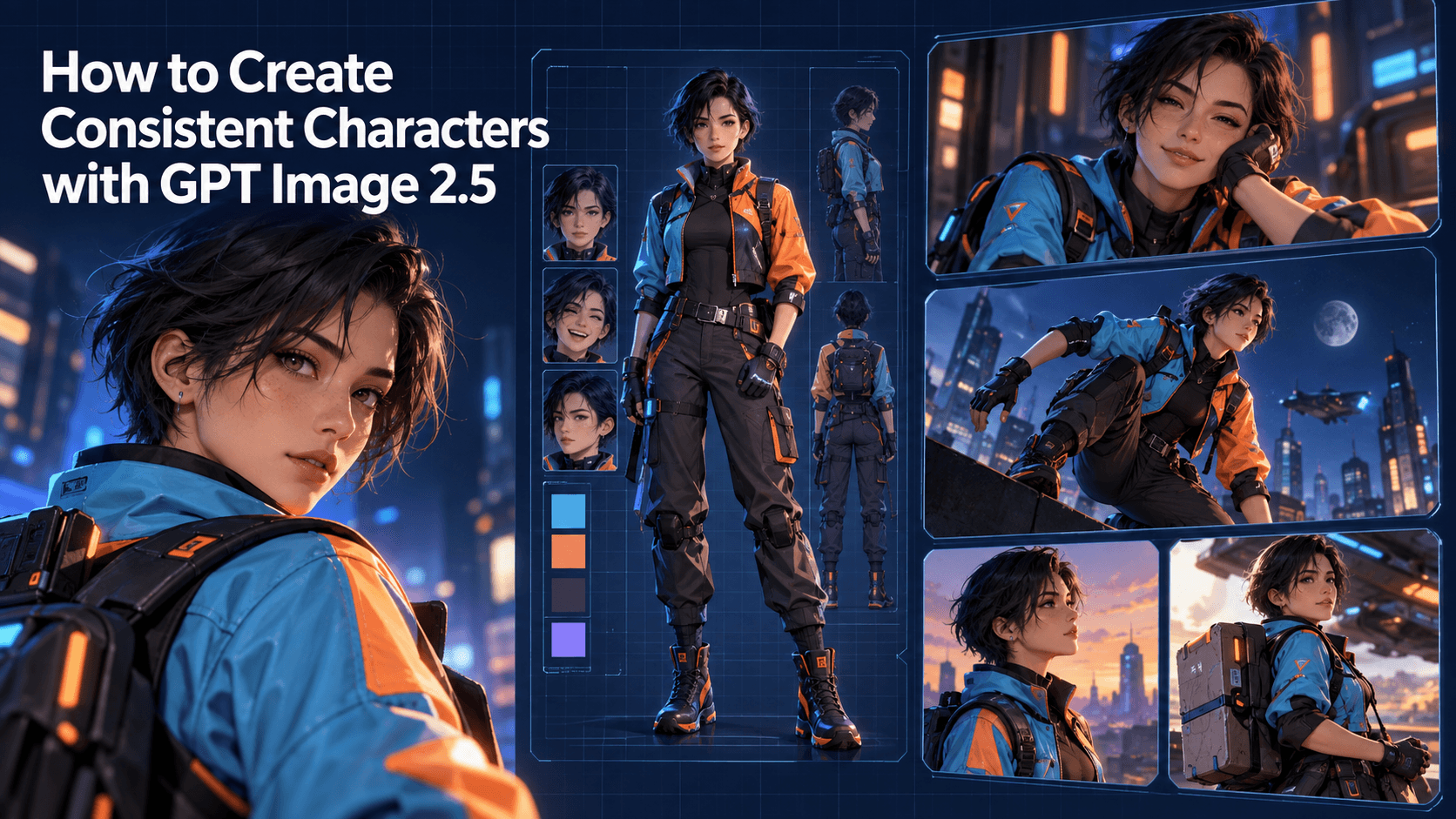
Build a usable character sheet
Create:
- neutral portrait;
- full-body front and side;
- back of coat and harness;
- five expressions;
- hands holding jar;
- work pose;
- casual outfit;
- palette;
- prop detail;
- simplified wide-shot design.
Write “must keep” and “may vary.”
Must keep:
- adult face and age;
- sturdy proportions;
- high hair puff;
- moss coat construction;
- transparent pocket material;
- harness;
- one cloud jar.
May vary:
- weather inside jar;
- gloves worn or clipped;
- coat open or closed;
- dirt and temporary tools.
This sheet is more valuable than ten dramatic portraits.
Test the OC in three story scenes
Work scene: She transfers rain from one jar to another. This tests hands, props, and outfit function.
Conversation: She argues with a city inspector while trying not to let the jar shake. This tests expression and character contradiction.
Failure: The memory of a thunderstorm begins to fade, and the jar’s lightning becomes unstable. This tests limitation and visual storytelling.
If the OC only works in a neutral pose, revise the design. If the power solves every scene, strengthen the cost.
Compare OC maker workflows
Run the same character brief in two tools.
Record:
- time to first usable design;
- diversity across four options;
- face and outfit consistency;
- success in the three test scenes;
- character-sheet quality;
- repair options;
- export quality;
- total cost;
- rights and privacy documentation.
Elser AI is especially relevant if the next step is a comic or animation, because the OC is part of the platform’s wider story workflow. A menu-based avatar maker may be faster for a profile image. A 3D creator may be necessary for a game.
The “best” choice is the one that supports the actual destination.
Give the character a voice without copying one
Write three voice rules:
- uses precise weather words but vague emotional words;
- never says “maybe” about plants;
- shortens sentences when anxious.
Sample:
Inspector: “Is that storm approved?”
Gardener: “It is contained.”
Inspector: “That wasn’t my question.”
Gardener: “It was the important answer.”
If generating voice, use a licensed voice or obtain consent. Do not clone a performer or acquaintance deceptively.
Rights and fan-inspired work
Original visual combinations can still resemble existing characters accidentally. Research and revise.
If you intentionally create a fan-inspired OC, label it unofficial. Do not use official logos, copied costumes, canonical claims, or protected assets for commercial work. An original person inside someone else’s protected universe is not automatically a commercially independent property.
FAQ
Before settling on a tool, export one finished character and reopen it elsewhere. Check whether resolution, background, color, and usage terms suit the next step. An OC maker is only genuinely beginner-friendly when the character can leave the generator and remain useful in a profile, reference sheet, comic, or animation.
What is the best OC maker for beginners?
A beginner needs a clear interface, reusable characters, and easy editing. Elser AI is worth testing when the OC will enter comics or video; menu-based avatar makers are simpler for a single profile.
Can I create an OC without drawing?
Yes. Text and reference-based tools can create visual drafts. You still need to direct, select, correct, and document the design.
How do I make an AI OC less generic?
Start with a contradiction, job, limitation, and relationship. Give visual details practical reasons and restrict the number of decorative anchors.
Can I sell my AI-generated OC?
Check the tool’s current terms, source rights, human authorship, and whether the character borrows protected franchise elements. Seek legal advice for important commercial projects.
Create Your Character Without Starting From Scratch
You now know how AI can help transform an idea into a complete character — but the real creative process starts when you begin experimenting.
With Elser AI, you can create original anime characters, fantasy heroes, game-style avatars, and story-ready designs using 50+ AI-powered OC Maker templates.
Choose a style, customize your character’s appearance, personality, outfit, and background story — or create a completely unique OC from your own imagination.
No drawing skills required. No complicated design tools. Just bring your idea, and let AI help you build it.
Start creating your first OC with Elser AI today.